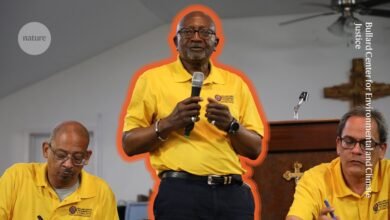
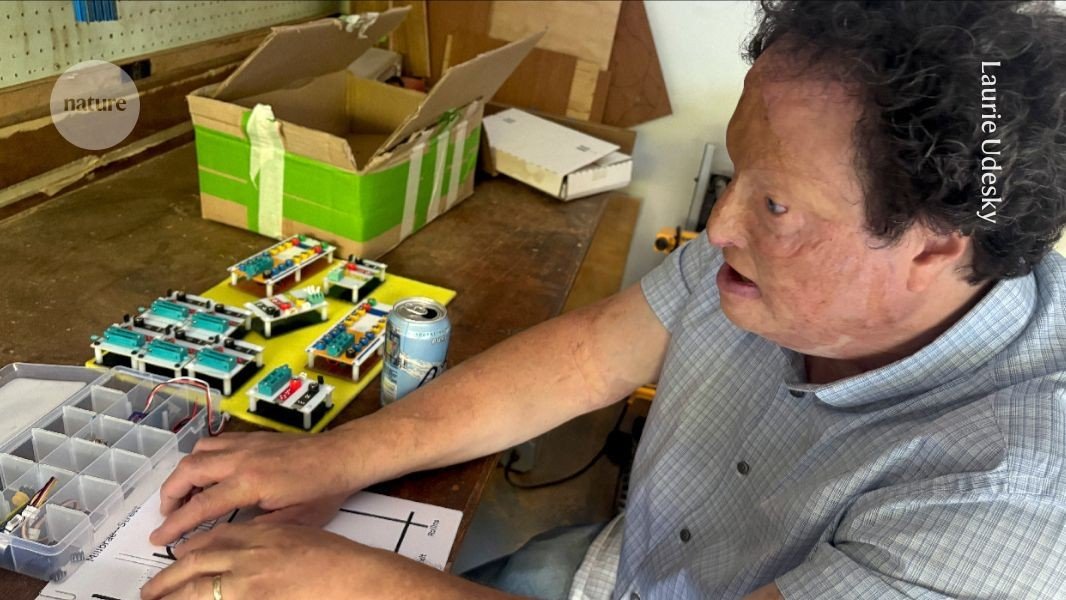


Josh Miele explains the nuances of a tactile map of a Bay Area Rapid Transit station.Credit: Laurie Udesky
Fifty-seven-year-old Josh Miele is a blind scientist, an inventor of adaptive technology and a 2021 MacArthur Foundation ‘genius’ fellow. In the 1990s, as an undergraduate and graduate student at the University of California, Berkeley (UCB) — before the invention of GPS — Miele could be seen around town climbing up street signs and feeling the embossed letters to work out which street he was on when travelling in unfamiliar areas, all to the surprise of bystanders. “Some accessibility is just about getting things done, and some accessibility is about teaching others about how much of a pain in the neck it is to get things done,” says Miele.
Structural biology for researchers with low vision
Miele was nurtured by his mother from a young age to buck the system. In his 2025 memoir, Connecting the Dots, he recounts a visit to an art museum, during which his mother urged him to get up close to a sculpture and “feel it with his hands”.
As he did so, he was mortified to hear his mother berating the museum staff for trying to deprive him of the hands-on experience. It was one of many instances of his mother making him “practise breaking the rules, thinking about when they needed to be broken and practising being visible, all of which are essential for me now”, says Miele, a polymath whose pursuits have included physics and space-science studies, working on a Mars probe and doctoral work on the psychology of sound perception. All of which would set him up for a career in designing accessible technology. Miele met a reporter from Nature’s careers team at his neat, compact woodworking studio in Berkeley, where he goes “to get out of his head”, carving chopstick holders and other things.
Outspoken start
Miele wasn’t born blind — a neighbour attacked him with acid when he was four years old, blinding and badly burning him. He reflects in his memoir that his young age probably protected his outlook: “I had a life to enjoy, and I couldn’t let being blind and burned prevent it.”
Instead, the incident forced him to begin engineering the world around him in his neighbourhood of Brooklyn, New York City, to make it work for him. He felt around his home to map it out, built a map of his neighbourhood in his mind and took apart radios and household appliances to understand how they worked. Miele used the echo of the sound his roller skates made to help him steer clear of objects that he might crash into while zooming down the pavement in front of his family’s house. At age 12, with a friend’s mother dictating instructions, he coded his first computer program, commanding an early home computer to count on screen from one to ten. In secondary school, inspired by the 1983 film WarGames “about a computer hacker guy with a talking computer” and with the help of his Braille teacher, Miele set up a speech synthesizer as a rudimentary screen reader on his home computer.
Several years later, during his physics undergraduate degree, he helped to update the features of outSPOKEN, a software for people with low vision or who are blind that reads aloud what is displayed on a computer’s graphical user interface. The Mac version was originally released in 1989 by Berkeley Systems, a small, local software company.
Miele got the job through his connection with Marc Sutton, whom he describes as “a laid-back blind hippie”. They met in The Cave, the basement of a UCB library in which blind students congregated to use Braille machines and other accessible equipment, talk about disability rights and learn from each other. Miele says that students worked and played hard at all hours in The Cave.
Working Scientist career profiles
His interactions with The Cave cohort and the wider disability-rights community marked a turning point for Miele. Before UCB, he says, “I didn’t think of myself as being part of a disability community. Why would I?” There weren’t any positive portrayals of blind and disabled people, in general, he says. With his new-found peers, he quickly realized that “we all deal with other people telling us that we can’t do stuff, building things that we can’t use and marginalizing us intentionally or unintentionally”.
A long-term friend and colleague of Miele’s who is also blind, UCB English professor Georgina Kleege, says that outSPOKEN was the first screen reader she ever used — although she didn’t know Miele at the time. “It changed my life. It made my life possible, because it meant I could use a computer,” she says.
In 1993, Miele pursued an internship at NASA’s Goddard Space Flight Center in Greenbelt, Maryland, indulging his childhood interest in rockets and outer space. There, he helped to develop software to calibrate optical sensors aboard the Mars Observer probe that launched in 1992. But the spacecraft disappeared before it entered Mars’ orbit.
Deeply disheartened, Miele felt like physics was no longer the right place for him. Once back in Berkeley, he realized that building accessible technologies “was probably the most value I could add”, he says. “I knew that it would be fun. I knew it would be interesting. I knew that there was plenty of work to do.” So, he put his undergraduate studies on hold to work full time at Berkeley Systems.
Quick-fire Q&A

Josh Miele enjoys playing music.Credit: 2016 Barbara Butkus
Why did it take 10 years for you to finish your undergraduate degree?
Because I find classwork really unsatisfying. I am motivated by doing things that make a difference in people’s lives. I’m always thinking about problems that people with disabilities have and I learn about new technologies as they come along. Sometimes things come to me in the shower.
Who are your greatest influences and mentors?
My stepfather, a geophysicist, was one. He was incredible at explaining things to me. For example, when I was young, he laid out two ropes on a table for me to feel to explain the difference between the wave height and wave density of AM and FM radio frequencies. Science-fiction writer Ursula Le Guin is another, because she wrote and thought about people in unusual ways. And she’s a master of the pencil sketch with words.
What drew you to playing guitar and being in a band when you were younger?
I love music and enjoy performing. And I wanted to be cool. As young kids, aged 13–14 years, we formed a band called Child Labor. It was a play on ‘Men at Work’, a group that was popular at the time.
A fresh direction
Eventually, Miele realized that he needed to return to UCB to finish his bachelor’s degree and did so in 1997. He’d already completed his physics requirements and spent his last semester taking courses in music appreciation, disability studies and psychology.
In 1998, he began his PhD in psychoacoustics and cognitive psychology at UCB. “I wanted to study ways of using non-speech sounds, including 3D immersive audio, to present information for screen-reader users, to speed up those interactions,” he says. For instance, he explains, imagine a screen reader reading out information in the top-left cell of a spreadsheet or table and it sounding like the voice was coming from the left and above the user. “It’s more efficient and intuitive than having the speech say ‘top-left cell’,” he says.
That same year, he started an internship at the Smith-Kettlewell Eye Research Institute in San Francisco, California. There, he worked on the data-analysis software MATLAB, to make it accessible to blind people. His Smith-Kettlewell stint evolved into a 19-year relationship, both during and after his PhD.
The institute’s environment “was incredibly flexible and accommodating”, says Miele. “It was also one of the few research institutions in the world that valued the kind of accessibility technology research programme that I wanted to build.” His proudest work included developing a way for blind and partially sighted people to print embossed, or raised, tactile street maps for any US location — to get a full picture of a neighbourhood or address through their fingers. Miele started the project, called tactile map automated production (TMAP), in 2003 as a postdoc at Smith-Kettlewell.
For it, he repurposed coding that he had developed for his graduate work, which enabled him to print research charts and graphs in Braille. He applied the program to data from geographical information systems (GIS) freely available through the US Census Bureau. Other people had used GIS to create tactile maps, Miele explains, but these required visual interfaces. “They were sighted people making maps for blind people.”

Josh Miele (standing) teaches a participant at a Blind Arduino Project workshop; he launched this series of maker gatherings in 2015.Credit: Jean Miele 2026
TMAP enabled blind people to create a Braille printable map at the scale and location of their choice and on their own. “This revolutionized the availability of tactile street maps for blind travelers,” noted a Smith-Kettlewell announcement in September 2021 (see go.nature.com/3zabzja).
Steve Landau is a close friend and frequent collaborator of Miele’s and the founder and president of Touch Graphics, an accessibility technology company in Newark, Delaware. The firm specializes in products that convey spatial information through touch. He has wrestled with Miele over the usability of the firm’s assistive technologies. Landau says that Miele can be blunt and has frequently “burst his bubble”, explaining why something he proposed won’t work.
These tools help visually impaired scientists read data and journals
Landau worked with Miele on creating a digital version of TMAP known as the Talking Tactile Tablet (TTT). One disagreement centred on how people would use screen touching on the tablet. As a sighted person, Landau explains, he was overlooking the complex ways in which blind people swipe and rotate their fingers on surfaces. “I needed to be schooled to make the device as intuitive as possible.”
The TTT enabled users to print an embossed map to overlay the tablet’s screen. Then, by tapping a map area, the tablet would spit out spoken information, such as street names, the number of traffic lanes, the direction of traffic and the location of pedestrian crossings. The handheld tablet worked well even for people who don’t know Braille, Landau explains.
Source link