
In some ways, finding exoplanets is amazingly easy.
It doesn’t necessarily take a huge telescope and sophisticated equipment to detect these alien worlds. Characterizing them, however—getting detailed information on their size, orbital period, and more—is usually more difficult.
Studying their atmospheres is currently at the cutting edge of what we can do, because that does indeed take state-of-the-art observatories. For example, astronomers can painstakingly gather a star’s light after it has physically passed through an orbiting planet’s air and look for the subtle signatures of various molecules absorbing some of that light at specific wavelengths.
On supporting science journalism
If you’re enjoying this article, consider supporting our award-winning journalism by subscribing. By purchasing a subscription you are helping to ensure the future of impactful stories about the discoveries and ideas shaping our world today.
But it’s not the only way to find and examine an atmosphere. Research published a few years back in the Monthly Notices of the Royal Astronomical Society (MNRAS) indicates another very clever method that astronomers could implement with a future space telescope.
They could look for exoplanetary rainbows.
There’s not a prayer of viewing one directly, alas; just getting a dotlike image of an exoplanet is already quite a task. But, with careful planning, some telltale indicators of rainbows and other optical phenomena can be seen.
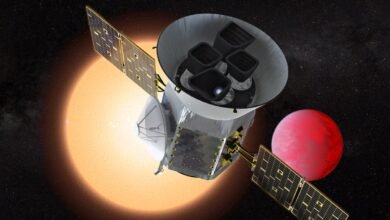
To be clear, none of these can be detected with our extant fleet of telescopes. But NASA is currently developing a mission called the Habitable Worlds Observatory (HWO), planned for launch in the early 2040s. This huge telescope will sport an at least six-meter light-collecting mirror and will be fine-tuned to look for Earth-sized worlds orbiting nearby sunlike stars in their habitable zone, the circumstellar region in which a planet can sustain liquid water on its surface.
Using HWO’s capabilities as a baseline, the astronomers responsible for that MNRAS paper investigated the prospects for detecting atmospheric phenomena such as rainbows, Rayleigh scattering and sunglint on exoplanets.
Observing such things, it turns out, is essentially a matter of perspective: They can all be revealed as an exoplanet goes through phases while orbiting its host star, just like the moon does as it orbits Earth. When the planet is between its star and us, we’re looking at its dark, unilluminated half (its “new” phase). As it orbits and appears to move away from the star, it exhibits a crescent phase, growing to appear half full at its farthest separation, then becoming full when it’s on the opposite side of the star from our viewpoint. The phases then occur in reverse order as it moves around the star and returns to its original “new phase” position. With a telescope like HWO, we wouldn’t see such phases directly, instead registering them as periodic brightness changes as a targeted exoplanet waxes and wanes.
The atmospheric phenomena potentially detectable by HWO depend on those phases and the angle between the planet, its star, and the observatory, and therefore are best seen at different times in the planet’s orbit.
Of these, sunglint is the simplest: it’s just the reflection of the sun on a body of water, such as a lake or an ocean. The surface of the water acts exactly like a mirror, bouncing incoming sunlight at an angle away from the sun. You can see this for yourself on a beach when the sun is low, with the bright reflection visible just under the sun in the water. This has also been seen from orbit many times in photos from the International Space Station and, in fact, was seen by the Cassini spacecraft at Saturn when sunlight reflected off lakes of liquid methane on its huge moon Titan.
Sunglint is seen when the angle between the sun, the water and the observer is very low, like at sunrise or sunset. For an exoplanet, it occurs when the planet is nearly between the star and Earth. From our viewpoint, the planet, if we could see it clearly, would be in a crescent phase.
In their MNRAS paper, the astronomers found that in projected HWO observations, the glint would add a small but significant bump in brightness to some planets at and near crescent phase. And because water and most other liquids can’t persist on a planet’s surface without an insulating blanket of air, seeing such a glint could signal the presence of an atmosphere as well.
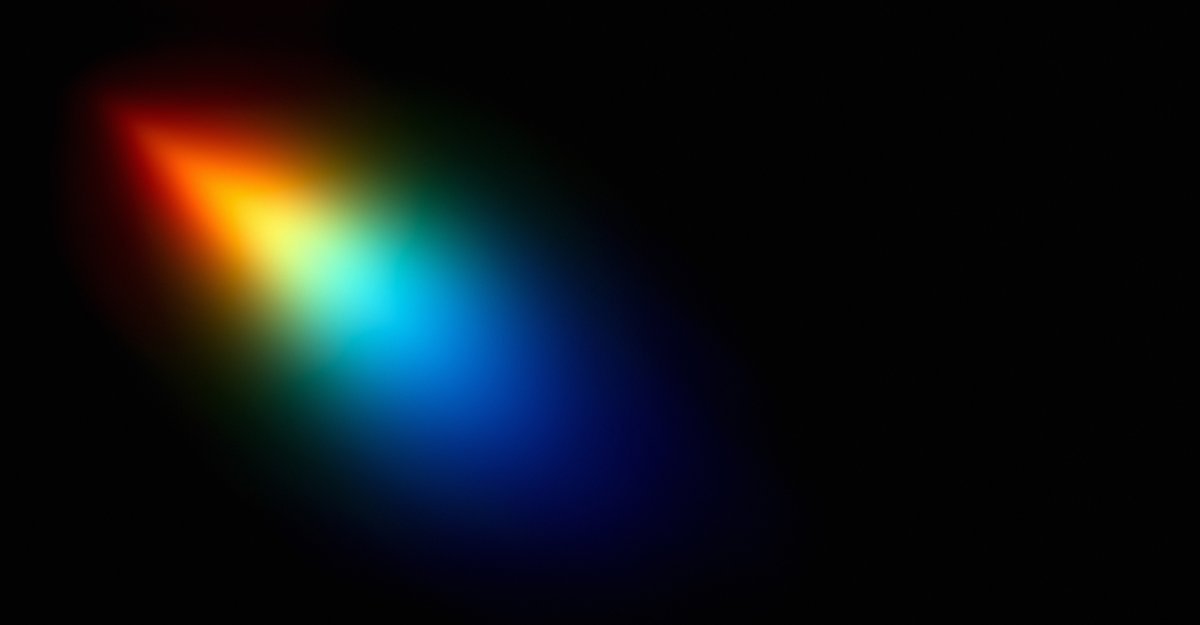
Rainbows on Earth occur when sunlight passes through raindrops. Different colors of light bounce inside the drops at different angles, so when they emerge they’re spread out. When we stand with the sun at our backs, the drops we’re facing send that light back toward us sorted by color, creating a characteristic prismatic arc in the sky: a rainbow.
If this occurs on an exoplanet, we won’t be able to see it directly. The light in rainbows is polarized, however. This means the waves all align. (For example, they oscillate up and down or left and right.) HWO will likely carry a polarimeter—an instrument designed to let through only the light aligned in one way—and the paper’s authors modeled what it might see. If an exoplanet is at the right phase, HWO’s polarimeter should be able to detect the extra bump in polarized light from potential rainbows (and related phenomena like glories, which have been detected on other planets). The amount of polarization can also reveal how big the rainbow-making raindrops are and possibly even their composition.
Rayleigh scattering occurs when incoming sunlight bounces off molecules like nitrogen in Earth’s atmosphere, and it makes our sky blue. This scattering also polarizes the light; the amount of polarization seen depends on the incoming light’s angle with respect to the observer.
You can see this effect for yourself on a clear, sunny day! Polarized sunglasses are essentially basic polarimeters. They have filters in them with molecules all aligned in one direction (usually vertically); light polarized vertically passes through that filter like a key in a lock, while light polarized in another direction (say, horizontally) does not. The sky’s Rayleigh scattering causes the strongest polarization of sunlight 90 degrees away from the sun: if you rotate your sunglasses around while looking through them, you’ll see the sky darken significantly as you do—the sunglasses block the light when the light’s polarization angle doesn’t match that of the sunglasses. Closer to the sun—though be careful and don’t look too close!—this effect is much smaller. This is the effect astronomers can exploit using HWO to look for signs of an exoplanet’s atmosphere.
Based on simulations using data from real stars HWO might survey, the team of scientists found that polarization signals of rainbows and sunglints should be detectable on a decent fraction of accompanying small, warm rocky worlds, while Rayleigh scattering would register for most of them—presuming they have atmospheres, that is. That’s the whole point: we want to optimize HWO’s ability to detect air on alien worlds, and searching for these optical phenomena would really give it a boost.
A blue sky, a poststorm rainbow and the sun reflecting off the ocean are sights we take for granted here on Earth. But they may be ubiquitous on planets throughout the cosmos. If they are, we may be on the verge of being able to detect them.
Source link