
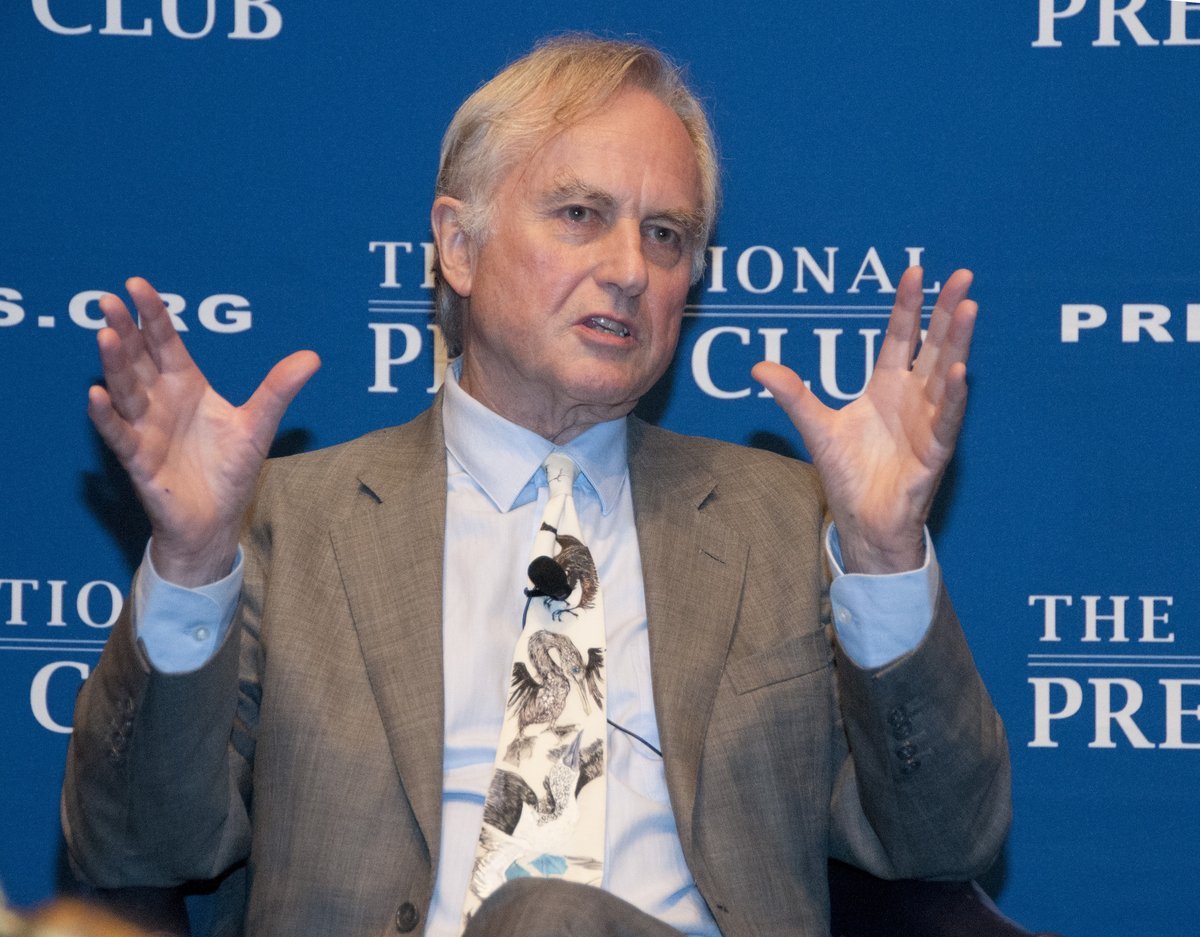

Fifty years ago Richard Dawkins, a young and relatively unknown ethologist at the University of Oxford, published what would become an instant bestseller and the catalyst for his ascension as a prominent public intellectual. As its title suggests, The Selfish Gene argued that evolution is driven by selfish competition among the “fundamental particles” of inheritance: genes. The book arguably did more than any other since Charles Darwin’s On the Origin of the Species in 1859 to make evolutionary biology a hot topic of cultural conversation.
Its message seemed stark, and it still sparks controversy. We are, Dawkins argued, merely the “survival machines” of our genes, compelled by them to act in ways that promote their own interests. As those interests are selfish, so we, too, are “born selfish.” What looks like altruistic behavior, then, is merely in the service of our genes’ selfishness.
“It’s such an extraordinary book,” says evolutionary biologist Arvid Ågren, author of The Gene’s-Eye View of Evolution. “It has come to play a unique role in evolutionary biology—simultaneously influential and contentious.”
On supporting science journalism
If you’re enjoying this article, consider supporting our award-winning journalism by subscribing. By purchasing a subscription you are helping to ensure the future of impactful stories about the discoveries and ideas shaping our world today.
The “gene’s-eye view” of evolution introduced by Dawkins remains a central feature of modern evolutionary theory. But what that perspective reveals about the relationship of genes and organisms is still debated. One problem is that there’s no consensus about what a gene even is. “‘Gene’ is one of those words in biology that means different things in different corners of the field,” Ågren says. And whether genes are truly selfish depends on what you consider them to be.
Dawkins defined a gene in his book as “any portion of chromosomal material which potentially lasts for enough generations to serve as a unit of natural selection.” That’s not an easy sentence to parse, but it makes the gene an abstract entity defined by its evolutionary role. The definition wasn’t really Dawkins’s, as he acknowledged; other evolutionary biologists, in particular Bill Hamilton, George Williams, John Maynard Smith and Robert Trivers, had introduced the concept years prior.
But when we hear today that a gene is linked to, say, the risk of a disease, the word has a rather different meaning. Here it generally refers to a small stretch of the DNA that constitutes our genomes, typically one that encodes the chemical makeup of a protein molecule. To a developmental biologist, such a gene is a resource that cells use to make and maintain the organism. But to an evolutionary biologist, a gene is like a little agent that develops strategies over the course of evolution to ensure its own persistence.
These are very different entities, although they are connected. The evolutionary biologist doesn’t much care what a gene does, so long as it somehow affects the traits and thus the fitness of the organism. The developmental or molecular biologist doesn’t much care how a gene got to be the way it is but wants to know how it influences growth, cell function and health. And so these disparate camps may find themselves talking past each other. The question that hangs over The Selfish Gene is whether, by failing properly to acknowledge the distinction—some might even say by obscuring it—the book sowed confusion about genes.
“At the heart of this confusion lies a disciplinary conceptual divide,” says developmental biologist Alfonso Martinez Arias of Pompeu Fabra University in Spain. Evolutionary, molecular and developmental biologists all have different concepts of the gene, he says. “Dawkins only thinks about the evolutionary biology view and has little knowledge, and certainly no understanding, of molecular or developmental biology.” Reviewing The Selfish Gene in 1977, molecular biologist Gunther Stent said that Dawkins’s definition “denatures the meaningful and well-established central concept of genetics into a fuzzy and heuristically useless notion.” Dawkins, Stent said, had committed a “terminological misdemeanor” quite deliberately “to provide himself with a catchy title.”

Oxford University Press/grinimal/Shutterstock.com
To make matters even murkier: whether you believe genes act selfishly depends not only on which kind of “gene” you’re talking about but also on what you take “selfish” to mean. In The Selfish Gene, “there are at least four [different] uses of ‘selfish’ that we glide between,” Ågren says.
For example, Dawkins says that two “genes” could compete for the same slot on a chromosome. But these are generally regarded as variants of the same gene, called alleles. If we’re speaking about alleles, selfishness seems an apt metaphor. As Dawkins says, an allele that results in an organism with longer legs to escape predators will be more likely to survive from one generation to the next, and so it will tend to become more abundant in a population’s gene pool. That is, this “long-legged” allele multiplies at the expense of others that are less fit. Kind of selfish, right?
Then again, every distinct gene in a given genome must generally cooperate with the others if the host organism is to exist at all. Naturally, Dawkins recognizes this too. In his 2024 book The Genetic Book of the Dead, he even showed a mock-up cover of The Selfish Gene with the title changed to The Cooperative Gene, which, he said, would have been equally consistent with the book’s content. But if a word works as well as its antonym, what explanatory work is that metaphor actually doing?
The problem is that the gene that is “selfish” is not the same gene that is “cooperative.” A gene encoding one kind of protein, for instance, doesn’t really act selfishly toward a gene encoding a different protein, because their interactions are not a zero-sum game. Indeed, they probably need one another.
The real point of Dawkins’s first book is not that (evolutionary) genes are necessarily selfish, even metaphorically, but that they can be considered from an evolutionary perspective to enact strategies that enable their persistence. That makes these strategizing genes sound like wily little agents. But in considering how genes act to build and maintain an organism, they are generally nothing of the sort, not least because DNA itself is inert. It’s only over many generations that this illusion of strategic agency becomes evident. As long as we remember that this pseudoagency is purely metaphorical, there’s no problem—but invoking it (as Dawkins has) to strip actual organisms of their genuine agency is problematic, to say the least. His portrayal of organisms as passive vehicles driven by agentic genes is a fair description of the gene’s-eye model of evolution. The trouble is, this image doesn’t do justice to what organisms really are and do.
A focus on what any given model leaves out can cut both ways, however: occasional “selfish” gene conflicts really can occur. For example, genes on the sex chromosomes (X and Y in humans) can act in their own favor to skew sex ratios in a population. What’s more, there are some segments of our DNA that really do seem to act with a selfish desire to proliferate at all costs. These are typically transposons—remnants of virus DNA that can accumulate in host genomes over time. Across many generations the build-up of transposon DNA that plays no beneficial role in the health of the host organism can clog the genome and compromise the fitness of other genes. This really is “selfish DNA,” although such sequences are not in general really genes in the developmental or molecular sense as they don’t affect the traits of the organism. Instead they are often given the more neutral label “selfish genetic elements.”
Such truly selfish DNA has long been of interest to evolutionary biologists, and work on it by Trivers was a major influence on Dawkins when writing The Selfish Gene. Some biologists interpreted his book as proposing that all genes have this sort of selfishness. If that were so, the “selfish gene” hypothesis would seem now disproven in general. Most of our DNA that serves some useful biological function is best regarded as cooperative.
Among experts, then, the perception of the book’s core meaning still varies based on discipline. Some will say it’s about competition of alleles; some will say it’s about selfish genetic elements; some will say it’s just a metaphor (but for what?); and some will say it simply means genes don’t care about one another (which is just another metaphor and is, in any event, not what “selfish” means).
That Dawkins’s book is written so beautifully perhaps disinclines most readers from worrying about such distinctions. But is that a problem? Given that understanding what genes are and what they do is more important than ever in our modern age of gene editing, genomic selection of embryos and an alarming resurgent interest in eugenics, the legacy of The Selfish Gene on its half centenary is complicated. Some researchers feel that its evolutionary message remains illuminating, while others, like Martinez Arias, worry that it has sown confusion about what our genes are really up to.
All this is to say that despite (or even because of) its myriad interpretive confusions, The Selfish Gene is still relevant. Debates over its fertile and provocative perspective are still shaping evolutionary biology and attracting newcomers to the field. It was and remains an “invitation to evolutionary biology that triggered the imagination,” Ågren says. “I was very seduced by that as a teenager.” But he cautions that, as with any science book, “if this is the only thing you read, you’ll be shaped by it, and you’ll think that’s the state of the field.”
In some respects, he says, pondering the meaning of Dawkins’s magnum opus is similar to wondering about the purpose of an evolution-sculpted genome itself: “To make the most of it, you must understand what it was designed to do.” And if the central metaphor has withered as we have come to understand more about the genome and about what genes really do, that is, after all, how science works: by proposing ideas that stimulate research until giving way to something better, more accurate, more true.
Source link