
With six hours left in 2025, the regular crowd at The Owl Music Parlor in Prospect Lefferts Gardens passed the bucket one last time. Everyone knew the rules, but manager Isaac Gillespie explained them anyway, holding it above his head like a grail as owner Oren Bloedow looked on proudly. These were his rules, after all, and in his kingdom, they were gospel. As ordained, the bucket migrated from wall to wall, swimming away from the unraised stage through five lanes of spindly wooden chairs and two sunken couches into the murkier, more turbulent waters of a crowded hall, past the bar to the picture window up front. A $15 donation was suggested; touching the bucket was required.
“It took me most of the life of the place to figure out what was wrong with the bucket. It used to skip sections and miss people,” says Bloedow, who ran The Owl, often single-handedly, from its opening on October 21st, 2015 until its closing on New Years Eve 2025. “I was still learning about it—and everything else, really—right up to the last day.”
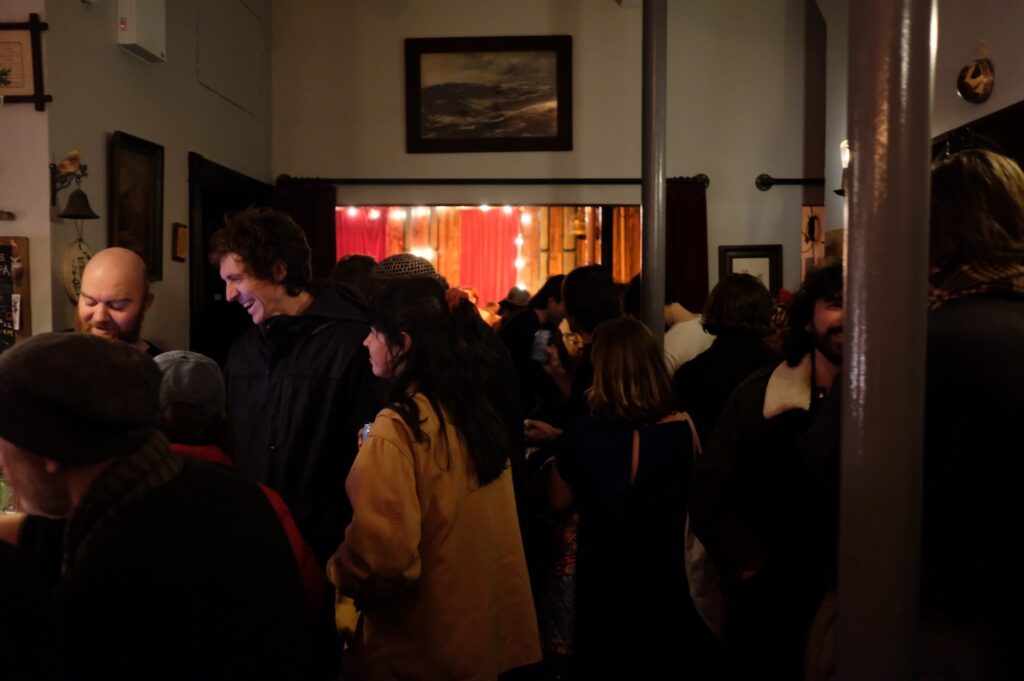
Photo by Raphael Helfand
Bloedow came of age in a thriving Downtown scene featuring clubs like CBGB and the Knitting Factory. He found his core community at the latter venue, but it was on tour in France with his and Jennifer Charles’s long-running dream-pop band Elysian Fields that he found the inspiration for his future venue. These clubs, he says, take every opportunity to make artists feel at ease—carrying their gear, feeding them gourmet meals, forging real kinship with the acts they host. “I even contemplated putting a pétanque court in the backyard as a small nod to that French family,” he says.
CBGB (long past its punk prime), the short-lived but legendary experimental music club Tonic, and the original Knitting Factory closed in 2006, 2007, and 2008, respectively. In 2009, Bloedow went looking for a building. It had to be cheap. It had to be three stories, the first zoned for commercial use and the top two residential; Bloedow would rent out the third floor to defray the cost of the building and live on the second floor to insulate his tenants from the noise of the venue. And it had to be near either the water or the park. The fixer-upper brownstone at 491 Rogers Avenue—two doors down from a firehouse in a (then) relatively ungentrified area of Central Brooklyn, just half a mile from Prospect Park’s east side—fit the bill.
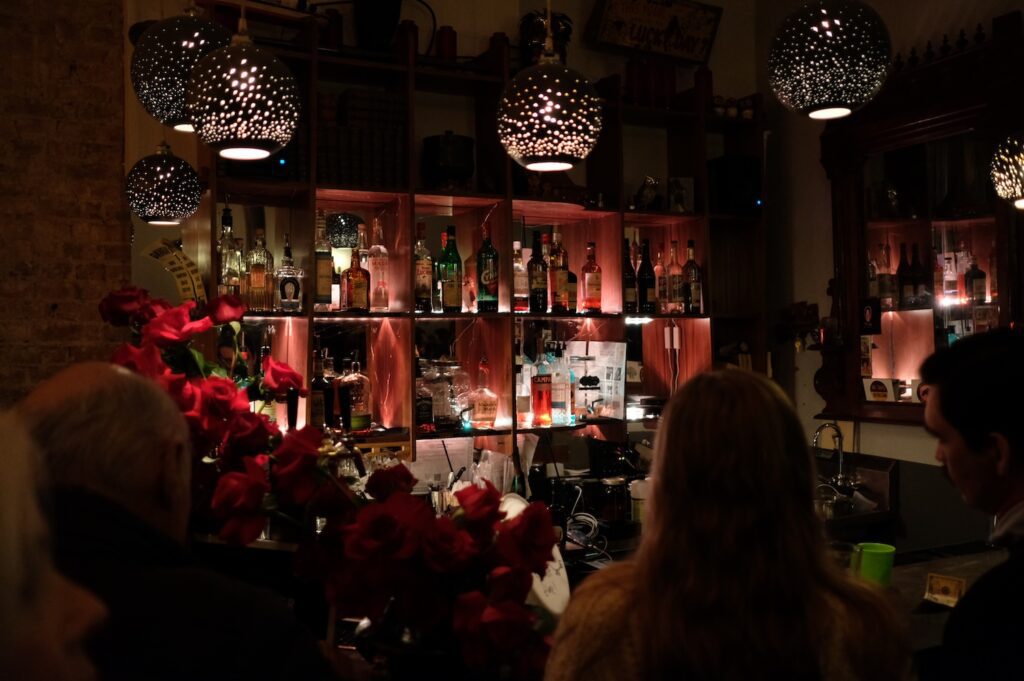
Photo by Raphael Helfand
The first few years were an uphill battle. His family had helped him with the cost of the building, but Bloedow poured all the money he made from his day job playing guitar in the first Broadway run of Fela! (the jukebox musical celebrating the life and work of Fela Kuti) into building repairs, toughing out two winters there without heat. Consulting Charles—whose elevated ideals for an Elysian Fields-worthy venue and keen aesthetic eye ensured Bloedow’s standards never sagged—on almost every decision, he turned major repairs into design opportunities: Rather than discarding the hundred-year-old pine beams they’d replaced with a steel support, for instance, they had them milled and turned into wall cladding, alternated them with soft panels to create a pattern of (sonically) reflective and less-reflective surfaces, and hung sleek white sound boards to mask the sheet-rock ceiling.
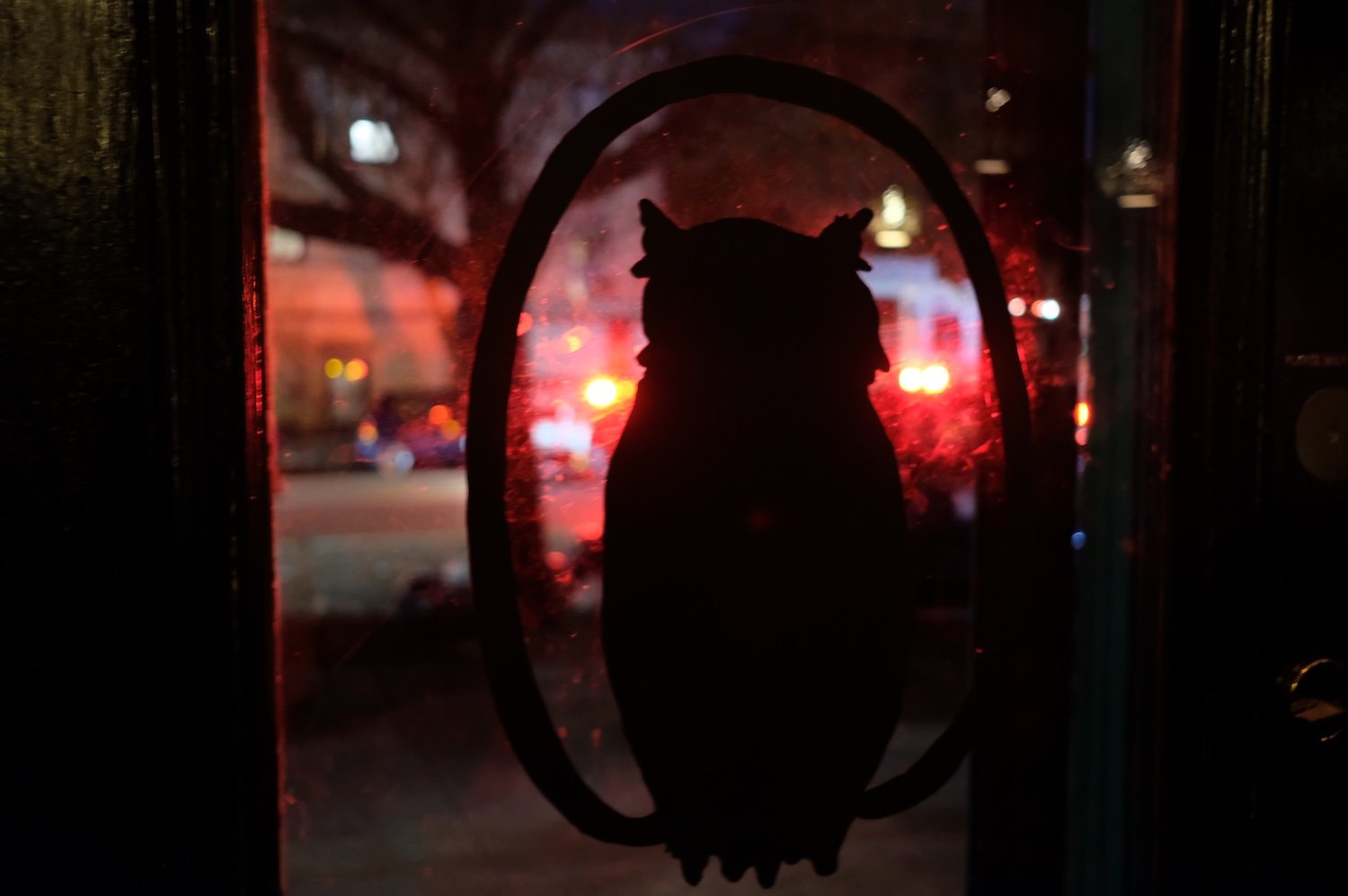
From fundamentals like the PA and backline equipment to decorative quirks like owl cages dangling from above and a foreboding “NIE DOTYKAĆ!” (“DON’T TOUCH!) sign purchased in Kraków and mounted above the lightswitch panel, they selected every piece with the utmost discrimination. Even the vigilantly maintained bathroom matched the venue’s classily cozy feng shui, outfitted with coffee-colored wallpaper and a stocky bookshelf where The Owl’s bravest visitors could avail themselves of classic tomes such as Adam Higginbotham’s Midnight In Chernobyl (not an original fixture of the venue but a well-thumbed volume nonetheless).

Photo by Raphael Helfand
At 8 p.m. on December 30, the regular crowd at The Owl prepared for a game of Socialist Pizza. Gillespie explained the rules to the room: A Good Samaritan had bought a dozen or so pies from Williamsburg Pizza to share with their comrades. The pizza was a public good, but it came with the explicit expectation that, come bucket time, the listening class would pay it forward, redistributing a bit more of their wealth than usual to the performing proletariat.
Halfway through a heavenly opening set from more eaze—violinist/vocalist/pedal steel player Mari Rubio backed by Sammy Weissberg on bass, Jade Guterman on guitar, Adelyn Strei on clarinet, and Wendy Eisenberg on piano—Gillespie returned to the stage to announce a problem. “There’s a very real possibility that we’re going to run out of beer tonight,” he said. “But don’t be alarmed. We bought a lot of weed, and you can have it for free at the bar. I know what’s coming in the rest of the evening, and I’m recommending… In fact, you probably should’ve already gotten high before this. I’m gonna put it on the edge of the bar.”

Photo by Raphael Helfand
He wasn’t joking. The rest of the night’s programming comprised an extended set from ur-goofball Frank Hurricane and a supergroup live scoring of the last hour of Princess Mononoke, punctuated by a brief, poignant performance from a barbershop quartet called Madhattan. The weed was available in three formats: low-THC chocolate chip cookies, high-THC gummies (“If you have two gummies, you will have more THC in your system than if you ate all of the chocolate chip cookies”), and loose leaf.
Hurricane ended his set with a story about a vegan friend who got salmonella simply from smelling the fumes of a rancid squirrel stew. “Things come and go in this holy world,” he said. “Simultaneously, everything lasts forever. I know this place is spiritual to a lot of you homies around here, and just like Holy Johnny Worley’s squirrel stew, and just like my boy’s salmonelly, it will go away, but it won’t really go away. It’ll always stick with you, and it’s amazing. That’s what life’s all about.”
The night was frigid and the smoking crowd was thin, but several scene veterans braved the cold to ruminate between sets. “I live down the road, and a large part of why I do is because The Owl is here,” said musician and journalist Andy Cush. “I’ve played here a lot and been here as an attendee even more than that. It’s the sort of place that doesn’t come around very often in New York, where you feel like there’s community happening pretty much every time you walk in the door.
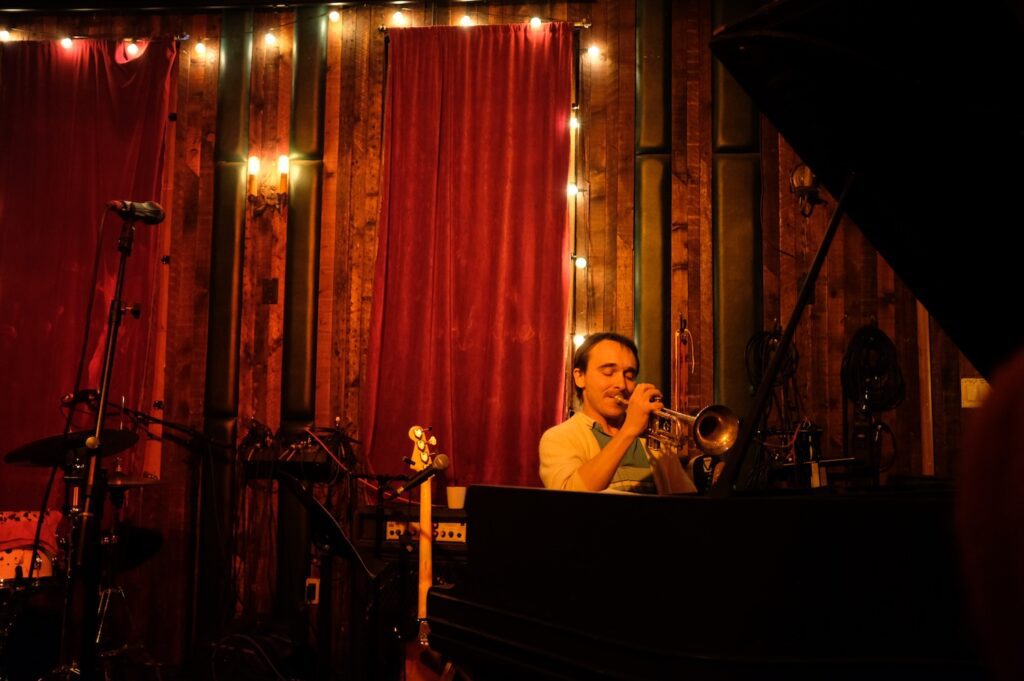
Photo by Raphael Helfand
“It’s like Frank said at the end of the set: ‘Nothing’s permanent, so you’ve gotta enjoy ’em while you got ’em,’” said drummer and interdisciplinary artist Greg Fox, before realizing his chocolate chip cookie had been laced with THC and leaving the scene.
“It’s been one of the safest-feeling places in the city for me as both someone who goes to shows and is part of this community,” said indie label manager and prolific sober showgoer Evan Welsh. “I’ve experienced too many life-changing shows here to count and have met very many good friends here. There’s gonna be a hole, and I hope it gets filled sooner than later. Here’s hoping.”
The Owl opened its doors on October 21, 2015. Its first month of programming consisted largely of Elysian Fields 20th-anniversary shows, but the calendar year culminated in a marathon evening of music led by local woodwinds warlock Levon Henry. “Levon brought in a couple dozen great artists all in one night, and some of them became pillars of the place,” Bloedow says. “Those kinds of nights would happen sporadically, and then there was also the slow flourishing of the scene [beyond that], like a garden where you encourage the plants that are thriving, and year after year they steadily spread out into the space. It was a fairly wild garden where things had a mind of their own, so I let ’em bolt and be rampant.”
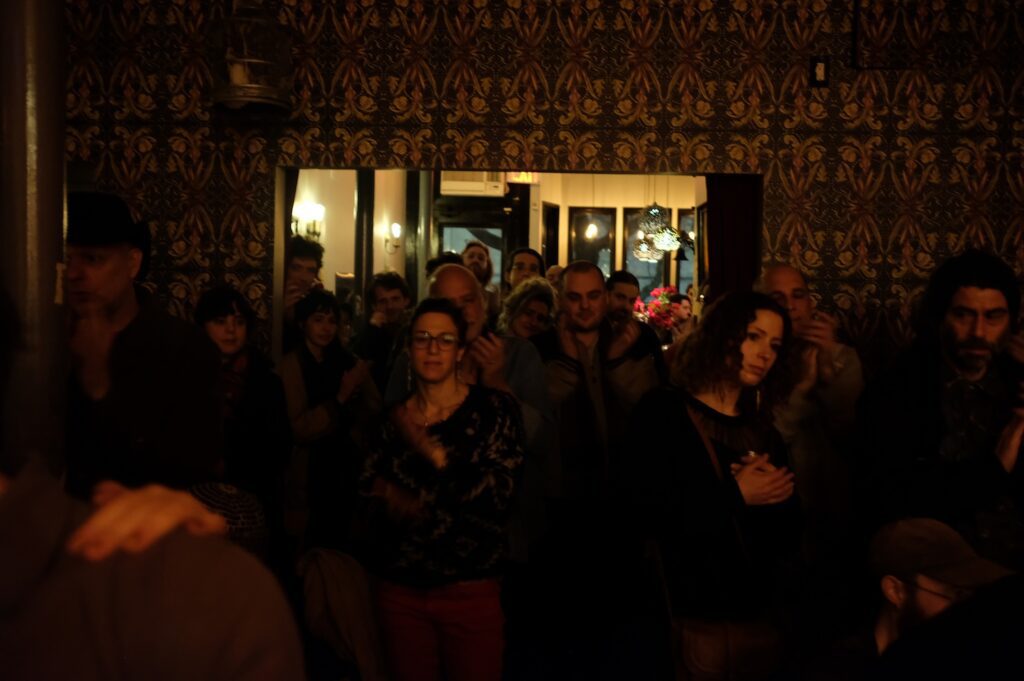
Photo by Raphael Helfand
COVID hit The Owl as it did every other independent music venue in 2020, but The Owl bounced back faster than most, cracking its doors in the late summer of 2021 before reopening in ernest that December. On the rebound from a cultural and socioeconomic drought, newly spawned hordes of music-hungry, contact-starved Brooklynites rushed to an oasis of artistic experimentation—discerningly programmed but adamantly inclusive, serious about the listening experience but not overly fussy.
“The Owl felt like an important bridge between the DIY/underground/house show scene and the ‘legitimate’ venue scene in the city,” says Wendy Eisenberg, who’s played there dozens of times as a soloist, band leader, and side player since moving to New York in 2016. “It became especially important as it outlasted places like Silent Barn and the Glove, those last holdouts from a certain underground scene where rare music was taken seriously.” Unlike most places with bona fide sound systems and multi-generational cultural caché, “The Owl let you be both quiet and strange,” Eisenberg says. “Most venues prize one or the other.”
Bloedow prized art over profit. Tickets to an Owl show were sometimes sold upon artists’ requests, but passing the bucket was the default. Artists who would have been turned away from other traditional venues for lack of funds were able to watch their idols, meet their future bandmates, and cut their teeth at The Owl. “Just by running a room where the music sounded good, the artists got paid, and the audiences always listened, Oren created a space where the prospect of making something new was again enticing,” Gillespie says. “In that way, the quiet legacy of The Owl Music Parlor’s post-2022 chapter will be the music careers that didn’t end and the bodies of work that result. Just by fighting to keep the bullshit down, Oren kept the flame alive for a lot of us.”
Artists confirm that Bloedow never took a dime from anything but the bar. And it often seemed like he was doing all he could to avoid making money from the bar too. Most music venues are liquor vendors first, leveraging their entertainment to herd their patrons toward the actual profit centers of their operations. But at The Owl, Bloedow says, the plan was to “de-emphasize” bar service from day one.
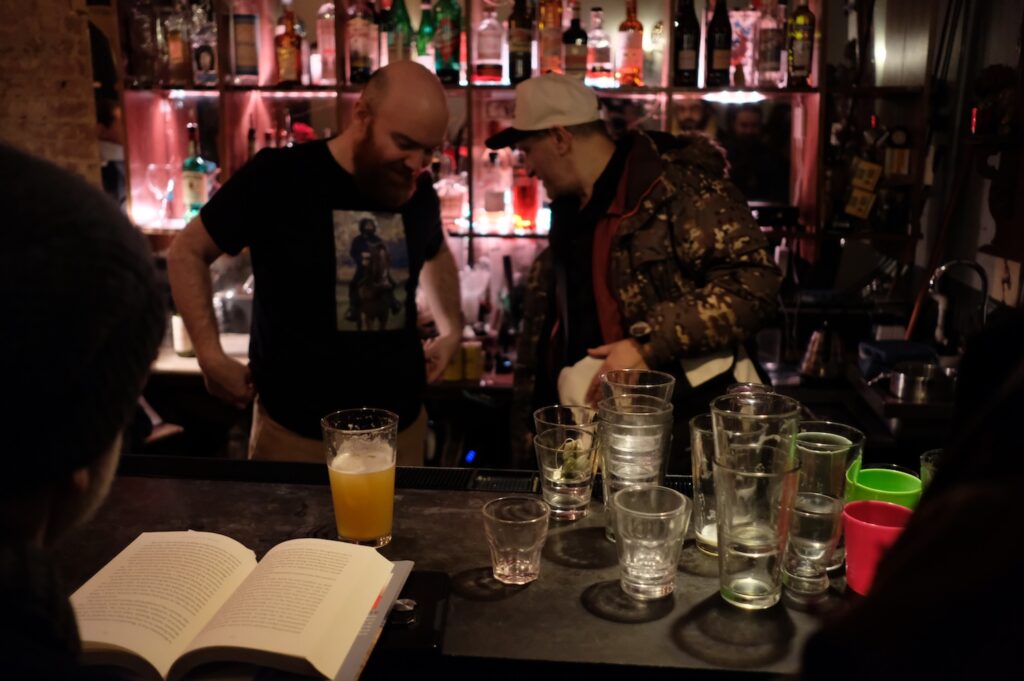
Photo by Raphael Helfand
“I had somebody come in one time who ran this really successful bar in Red Hook,” Gillespie remembers. “And he was like, ‘I could tell you 10 ways to make more money from this bar right now.’ But he loved it. He loved the experience of being at the bar more than if we had done those 10 things to make every dollar that we could have made.”
On September 20, 2024, subscribers to The Owl Music Parlor’s newsletter were informed that 2025 would be the venue’s final year. “I wouldn’t elect to undergo this painful amputation except this is an opportune moment for me to free up some of the time, energy and money that the venue demands and channel those resources into my own music,” Bloedow wrote.
The Owl didn’t close because of rising rents, Yuppie neighbors, police harassment, or any of the usual Brooklyn powers that be. Bloedow’s relative financial security and actual adulthood allowed him to build his utopian vision of a venue while avoiding the pitfalls that broke, idealistic 20-somethings (or even idealistic 20-somethings with trust funds) face when trying to forge ambitious spaces in legal gray areas on shaky strategic foundations. Still, he ran the place as a truly DIY endeavor, and that takes a toll on anyone.
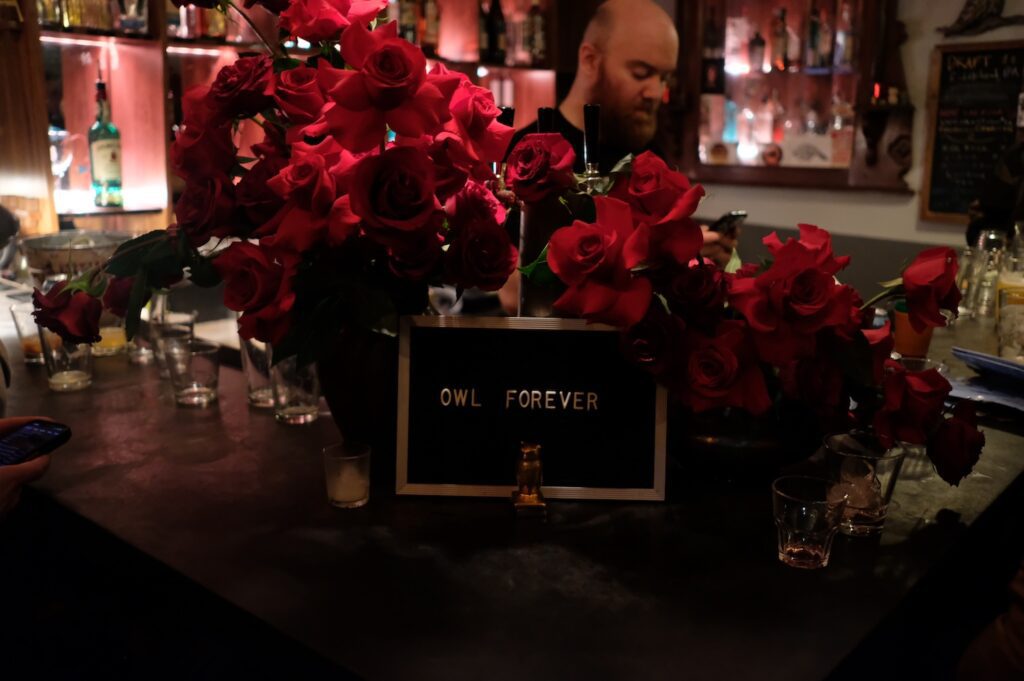
Photo by Raphael Helfand
“I was struggling too much with self-care things like diet, sleep and exercise, joint and spine health,” he says now, “and my highest priority anyway is always my own and my collaborative music projects. I reckon I am one of the few working guitarists who sanitizes the bathroom on the way to the stage. Using my hands for things like that—hours of scrubbing and little cuts with lemon and dirty dishwater in them—doesn’t go well with using them to play. In fact, I managed to get a deep cut on my fingertip that required six stitches just as I was closing up at the end of our very last night. When I got to the ER, they had all my information and my tetanus shot was still up to date because they had already stitched me up once this year.”
Even in his farewell email, he expressed hope that The Owl “could rise from the ashes… as a nonprofit institution”—perhaps in a new location with 30 extra seats, even. “I’m going to look into that,” he wrote, and while he certainly still seems to be entertaining the possibility, it’s not the first thing on his mind in the aftermath of the venue’s closing. Gillespie and his wife and co-manager Caitlin McConnell, on the other hand, are eager to start the search. “The Owl created ripples that will live on in the music and creative worlds of New York,” McConnell says. “We hope to carry on that work and make Oren proud.”
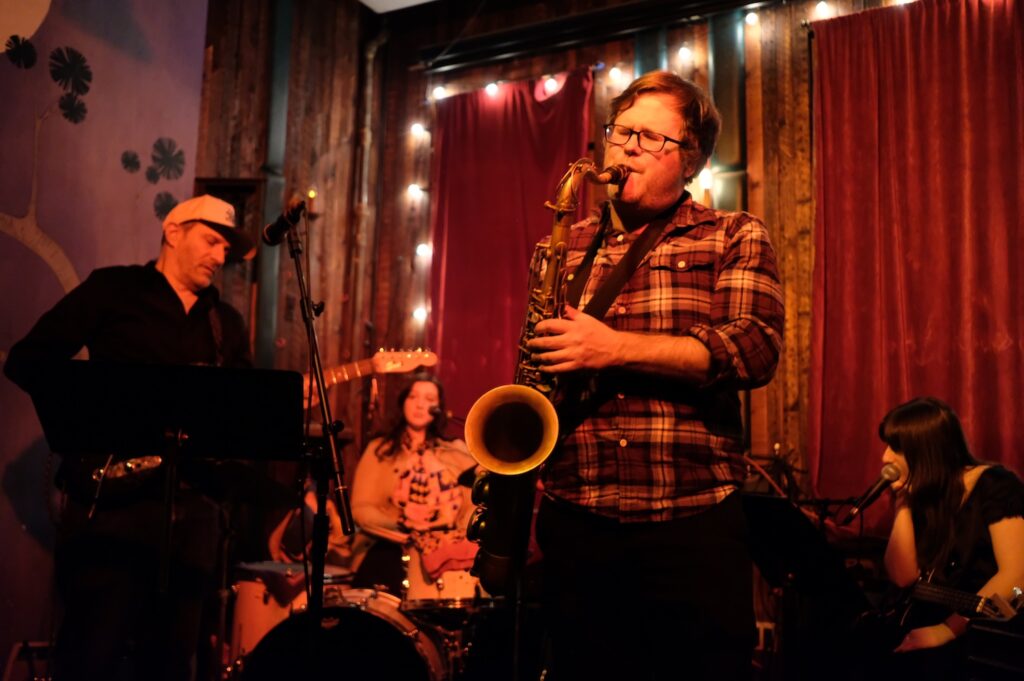
Photo by Raphael Helfand
Around 7 p.m. on New Year’s Eve, everyone got on stage. All the musicians, at least. Most of them, anyway (missing were Nuria Graham and Freedy Johnston, who’d played earlier in the evening). In his final act as ruler of The Owl Music Parlor, Bloedow fronted an ad-hoc six-piece band—with Rachel Housle on drums, Sofia Wolfson on bass, Christian Li on keys, Alex Toth on trumpet, and Sam Decker on sax—for an electric rendition of David Bowie’s “Changes.” If it was corny, it was beautiful too.
Outside in the cold, a group of Owl newcomers brought by a friend on a whim for the venue’s final night marveled at the magic they’d caught on its way out the door. “I loved how chaotic it was,” said a first-timer named Amanda before a fire engine siren drowned out the rest of her sentence.
“It was shambolic, and I was running into tons of problems, and everybody was beautiful, and the vibe was great, and the room was full of love, and music survived,” Bloedow says, a few days removed from the action. “It was blooming in the room.”
Asked to name the moments when The Owl bloomed the brightest, though, he looks almost offended. “Absolutely not,” he says. “If there’s anything I’m happy about, it’s how often it was just blazing in there. Rather than saying, ‘What an incredible cosmic event that was, the singularity, the total eclipse,’ what blows my mind is how incredibly starry the sky was. 80% of the time it was great. 25% of the time it was unbelievable.”
The post Last Call at The Owl appeared first on BKMAG.