
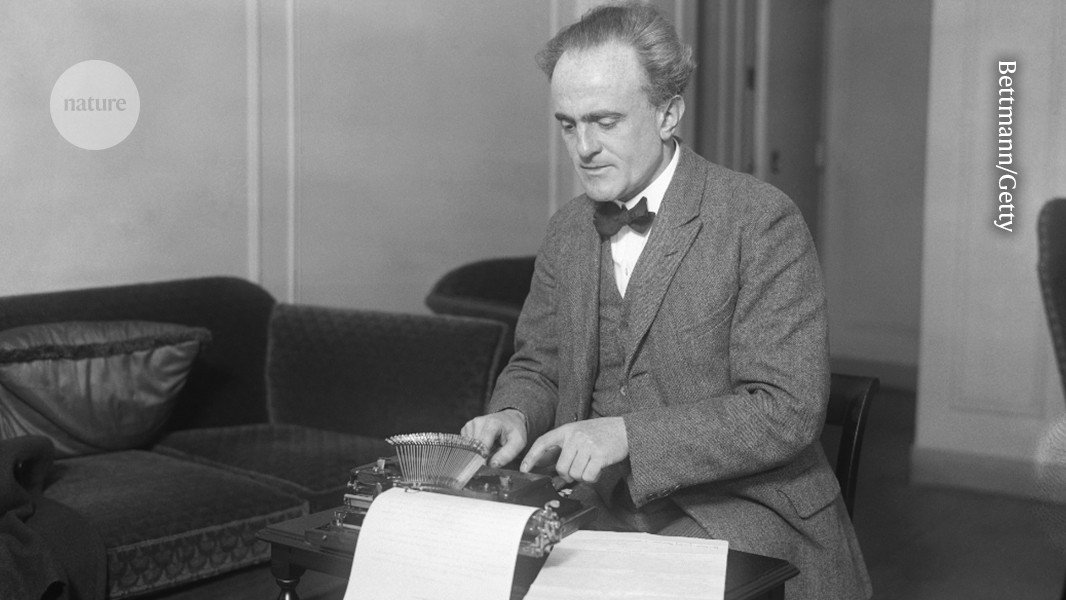
Fraud sealed the fate of controversial zoologist Paul Kammerer — 100 years on, his ideas deserve revisiting

One hundred years ago, on 23 September 1926, zoologist Paul Kammerer shot himself on Hochschneeberg, a mountain plateau southwest of Vienna. He was discovered slumped against a rock by a retired railway worker who had followed the barking of the dogs Kammerer had taken with him on his final walk.
Shock at the zoologist’s death made headlines, and the reasons for his suicide are still debated. Kammerer was an internationally famous scientist, described as a “successor to Darwin” in The New York Times. His charisma, unconventional career and turbulent personal life were well known.
Kammerer’s death occurred just a few weeks after he was accused of academic fraud — evidence of tampering with his most famous experiment was found by the US herpetologist Gladwyn Noble and set out in a news article in Nature1. Kammerer’s suicide has been seen by some as an indication of his guilt, leading many scientists to dismiss his life’s work.

The ‘crazy rule-defying’ genes that determine sex
Kammerer’s reputation among his colleagues was also tainted by his success at popularizing his own research in books, articles and public lectures. Although such outreach would get a better reception today, in 1919, a committee of the Philosophical Faculty at the University of Vienna that was considering his (unsuccessful) application for promotion to associate professor described him as “journalistic”, “unscientific” and a self-publicist2. His reputation wasn’t helped by his publication of unconventional ideas: his 1919 book The Law of Seriality posited that a universal principle underlies everyday coincidences.
Nonetheless, this complicated man was also a skilled zoologist, capable of raising sensitive animals such as amphibians and posing questions that still resonate today. He was also a passionate pacifist and internationalist in a time of growing nationalism. As I describe in this article, discoveries in the century since his death might even go some way towards rescuing his scientific reputation.
A colourful life
Kammerer was born in Vienna in 1880, the only child from the marriage of his father Karl, a well-to-do owner of an optical instruments factory, and his mother Sofie, a passionate pianist. Both had been married before. With a foot in both science and the arts, his studies at the University of Vienna spanned biology and musicology (including composition and piano). His doctoral work was started at the university and completed at the private Institute for Experimental Biology (known as the Vivarium) in Vienna, where he would spend most of his career.
Kammerer’s warm character, good looks and honest demeanour were mentioned repeatedly by those who met him. As the writer Arthur Koestler noted in his 1971 account of Kammerer’s life, The Case of the Midwife Toad, acquaintances described him as a “frank open-hearted man” with “great charm and integrity”, and as “quite sincere, genuine and … earnest”. His vanity and his attractiveness to women, however, led to a complicated and sometimes troubled personal life.
While still a student, he vied with composer Alban Berg for the affections of the soprano Helene Nahowska (rumoured to be the illegitimate daughter of Kaiser Franz Joseph I). In 1907, he jumped up in the social hierarchy when he married Baroness Felicitas Maria Theodora von Wiedersperg, known as Dora.
Then, in 1911–12, he passionately pursued the musician Alma Mahler-Werfel — the widow of composer Gustav Mahler — even threatening to take his own life on her late husband’s grave if she would not marry him, which she would not. In 1922, he began a brief and troubled second marriage with the painter Anna Walt (during which he attempted suicide twice), before returning to von Wiedersperg in 1923. At the end of his life, he was unhappily entangled with the (married) Grete Wiesenthal — a pioneer of modern dance and inventor of the solo waltz.
Surprising findings
Kammerer’s scientific career was no less eventful. It began with great promise when he won a prize for his 1904 doctoral work looking at the effects of environmental change on the reproductive biology of two salamander species.
The fire salamander, usually found in lowland areas (Salamandra salamandra, formerly S. maculosa), lives in warm and wet conditions and produces a couple of dozen tadpoles at a time. The related alpine species (Salamandra atra) lives in colder, drier conditions and typically produces two offspring, which emerge from the mother not as tadpoles, but in the form of a miniature adult.
By forcing the lowland species to live in the waterless habitat of its alpine relative, Kammerer persuaded the former, over several seasons of reproduction, to adopt the latter’s way of reproducing. Even more extraordinary was Kammerer’s claim that, in some cases, this drastic change — induced in a single generation — was passed on to offspring as if this new characteristic had become encoded in the salamanders’ genes.
The effect of a changing environment on an organism’s appearance is familiar — think of skin becoming tanned in the Sun. But the idea that such changes might be passed on to future generations — a concept attributed to French zoologist Jean-Baptiste Lamarck in the early 1800s — was unfashionable in the early twentieth century. By then, evolutionary change was widely understood to occur through the natural selection of variants of genes.
Support for Lamarckism dissipated in the late nineteenth century when German biologist August Weismann postulated that germ cells — sperm and egg cells — were different from other cells in the animal body and were uniquely capable of passing characteristics on to the next generation. Changes to the body over a lifetime were invisible to germ cells, and so could not be inherited, Weismann reasoned. He tested this by cutting off the tails of mice for five generations and showing that the tails in the sixth generation were in no way shortened.

Some of Kammerer’s works focused on changing the reproductive biology of salamanders.Credit: The Picture Art Collection/Alamy
The rediscovery in 1900 of biologist Gregor Mendel’s studies of inheritance in pea plants also revealed the existence of genes, which, although they might vary, generally passed unaltered from one generation to the next.
Nonetheless, Kammerer’s apparent evidence for the inheritance of acquired characteristics became the focus of his research. In the next decade and a half, he published evidence for biological changes in several kinds of animal that were induced by modifications to their environment, and the subsequent inheritance of these characteristics by later generations.
He showed that cutting off the tubes (known as siphons) through which a type of sea squirt (Ciona intestinalis) suck in and expel water as they feed caused the animals’ siphons to grow back longer. Their offspring had longer siphons, too. Kammerer also showed that blind, cave-dwelling salamanders called olms (Proteus anguinus), whose larval eyes usually degenerate, retained their larval eyes into adulthood if raised under specific wavelengths of light.
Most famously, he took midwife toads (Alytes obstetricans) — which, unlike most amphibians, reproduce on land — and raised them in hot, dry conditions, forcing the animals to spend their time in water. Along with changes to the toads’ eggs and tadpoles, the water-dwelling males developed rough and pigmented ‘nuptial pads’ on their forelimbs that, as is typical of their water-mating cousins, helped them to grasp slippery females when mating.
These pads, which are not usually found in these terrestrial toads, were passed on to subsequent generations, and in proportions suggestive of Mendel’s gene theory.

It’s time to admit that genes are not the blueprint for life
In interpreting these results, Kammerer accepted the central role of genes in inheritance and Darwinian evolution by natural selection. But he claimed that these studies showed there could be a two-way street by which the cells of the body were not only patterned by genes, but also able to influence those genes permanently.
Kammerer was dissatisfied with the seemingly pessimistic idea of evolutionary change through the brutal, competitive selection of random and directionless mutations. He had a more optimistic view of how evolution worked.
He urged that his discoveries be put to good use through a kind of positive eugenics.
In this theory, the studiousness or piano practice of a parent, for example, would not be lost on their death but could also benefit their children and grandchildren. He even suggested that the 1920s prohibition of alcohol in the United States promised a nation of natural teetotallers down the line.
The First World War inevitably interrupted Kammerer’s laboratory research. Classed as unfit to fight, he worked as a censor and continued to lecture and write, publishing articles promoting pacifism and internationalism, as well as his book on coincidences.
After the war ended, Kammerer left the Vivarium, his living menagerie and preserved specimens having been mostly lost. To make ends meet in post-war Vienna, he wrote for newspapers and gave lectures to the public. In 1923, he travelled to the United Kingdom to speak at the University of Cambridge and the Linnean Society in London, and in 1924–25 he undertook lecture tours in the United States.
Widespread accusations
Kammerer’s work was always controversial — it was anathema to the new generation of geneticists. Most notable among his adversaries was the Cambridge geneticist William Bateson who, in a fierce letter to Nature published in 1919, outlined his long-standing doubts over Kammerer’s results3. In 1923, just after Kammerer’s UK talks, his experiments on toads and sea squirts faced a fresh barrage of criticisms, including a back-and-forth involving dozens of letters in Nature.
What came next is described in Koestler’s book, for which the author was able to correspond with several protagonists who were still alive at his time of writing. He recounts how, early in 1926, Noble had visited Vienna and examined Kammerer’s last-remaining pickled specimen of a male midwife toad.

Sex, drugs and the conscious brain: Francis Crick beyond the double helix
Source link