

Credit: Fadel Senna/AFP via Getty
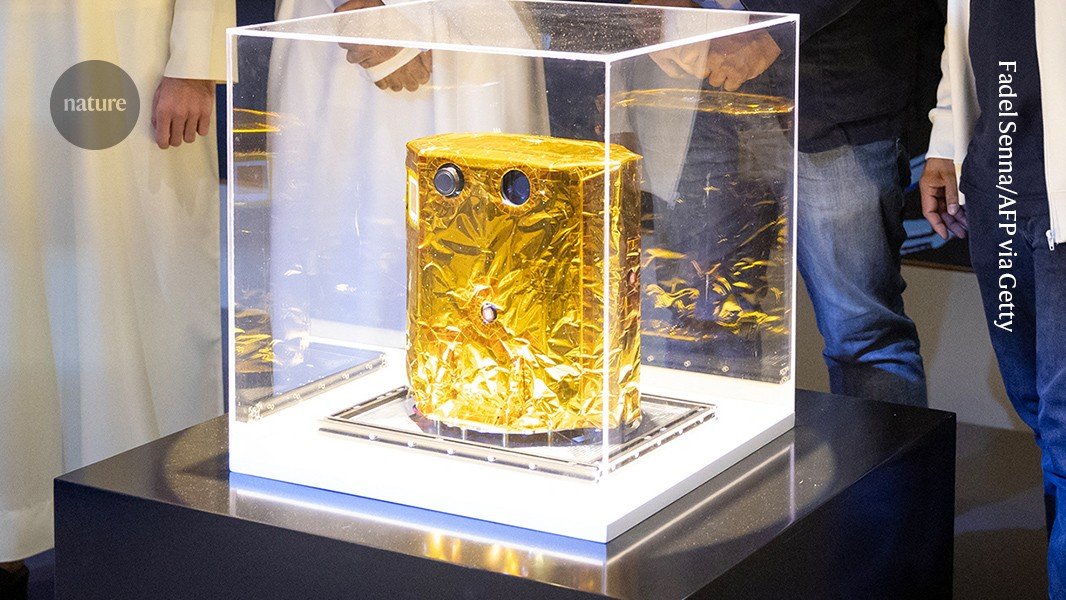
The United Arab Emirates (UAE) is on course to become the fourth space power to touch an asteroid, according to scientists and engineers involved in the country’s space programme. On 1 October, they announced the completion of a probe that is expected to career into the reddish rock known as Justicia in 2035.
The probe was designed and built in the UAE. It will now be shipped to the University of Colorado Boulder, where collaborators will integrate it with the main MBR Explorer spacecraft before a launch scheduled for March 2028.
The Emirates Mission to the Asteroid belt (EMA) will observe six asteroids using an array of cameras and spectrometers, which can analyse material composition remotely. It will also observe Venus and Mars, before the MBR Explorer spacecraft dispatches the tiny 10 kilogram probe to its final destination, the asteroid Justicia.
Justicia’s unusual red colour suggests that the asteroid contains materials more commonly found further out in the Solar System than its current orbit between Mars and Jupiter. If it originated in the outer reaches and migrated inwards, that makes it an ancient “traveller from the past” that could give clues as to how the Solar System formed and the origins of its water, said Elias Tsoutsanis, chief researcher for the Propulsion and Space Research Center at the Technology Innovation Institute (TII) in Abu Dhabi. The TII is a government-backed research agency that designed and developed the probe. Tsoutsanis was speaking at an event in the city on 1 October marking the probe’s completion.
Going solo
The asteroid mission will be the country’s second interplanetary venture, building on the success of its Hope orbiter, which reached Mars in 2021 after six years of development.
The UAE’s relatively quick ascent into the club of space-faring nations has come through a programme of hiring international partners who have helped to design and build their various spacecraft while also training Emirati researchers and engineers.
The progress on the latest mission shows the UAE’s growing independence in space science and technology, said computer scientist Najwa Aaraj, chief executive of the TII, at the 1 October event. Whereas every part of Hope was a collaboration, the UAE built the probe component of the EMA on its own. “I’m very confident that in the next mission, we don’t need Colorado,” she added. “Everything can be done end-to-end here.”
The country’s activities in the skies seem to be having an impact on the ground. Since the UAE announced its plan to send a mission to Mars in 2014, there has been a 30% rise in students enrolling in science, technology, engineering and mathematics, said Ahmad Belhoul Al Falasi, chair of the UAE Space Agency, at the event. Between 2015 and 2025, the number of UAE universities offering aerospace engineering and space-related degree programmes has roughly doubled, he later told Nature.
Source link