
Keir Starmer, the previous Labour Prime Minister, undertook what he called a reset of Britain’s relationship with the E.U. But, since it was Starmer, this became a mishmash of “structured dialogues,” “deliverables,” and “milestones,” which meant that nobody really understood what he was talking about. Part of the confusion was inevitable. Anything involving heavy-duty negotiations with the E.U.—with its twenty-seven member states and its formidable corpus of shared rules and regulations—is wildly complicated and dull. But at least part of Starmer’s opacity was calculated. For years, under Jeremy Corbyn and then under Starmer, the Labour Party was terrified of being seen as anti-Brexit, for fear of alienating working-class, socially conservative people in poorer parts of the U.K. who had voted to leave.
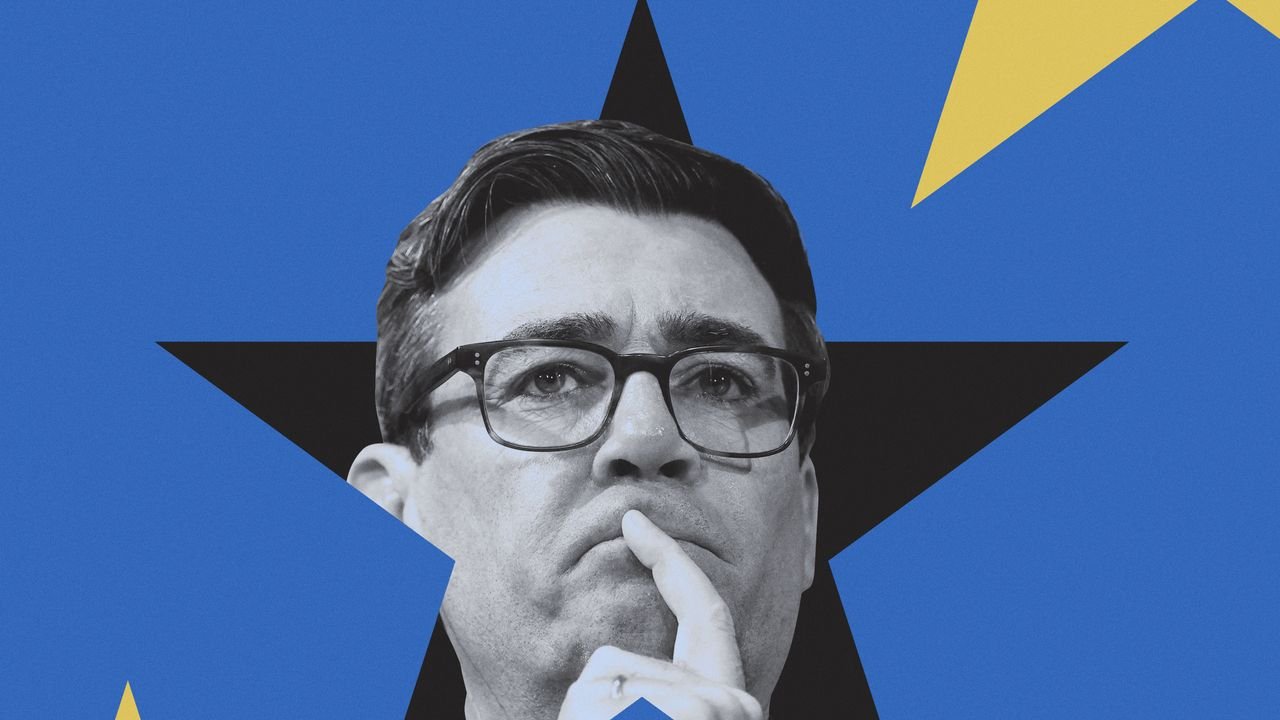
Under Burnham, that calculus has changed. Brexit supporters are an older breed. Since 2016, an estimated four million of them have died. During the same period, younger and progressive voters have been drifting away from Labour to more explicitly pro-European parties, such as the Liberal Democrats and the Greens. (British voters who were too young to take part in the referendum oppose Brexit by a ratio of around five to one.) “The core of Burnham’s strategy is based on trying to reunite the left,” a former government adviser told me. “He believes that the contest for the next election is not so much about swing voters—it’s about who can marshal their bloc and bring their bloc together. And those blocs are essentially who voted Leave or Remain in 2016.”
On November 20th, Burnham arrived in Brussels to sign a new set of agreements designed to improve the U.K.’s relationship with the E.U. Almost everything on the agenda—dropping border checks for food exports, connecting to the E.U.’s carbon market, developing closer coöperation to stop irregular migration, and starting a youth-travel program—had been negotiated during Starmer’s premiership, but Burnham framed the meeting as part of a longer journey. A few days before he went, he likened Brexit to the emperor’s new clothes. “I do try to say things as I see them,” he said.
Yet Burnham never quite says that he wants to reverse Brexit. (He has said that he would like to see Britain rejoin the E.U. “during my lifetime.”) He has promised to respect Labour’s previous “red lines”—staying outside the central structures of the E.U.—until the next election. In the meantime, however, the Prime Minister has said that he wants to start talking “about options for our long-term relationship.” If you are old enough to remember the enervating, epic, soul-sapping awfulness of leaving the bloc in the first place, you know that this can mean only one thing. As Nigel Farage, the Brexiteer-in-chief, told the BBC, “I’m sure many listeners to this program right now will be saying, “Oh, no. Not again.”
Burnham arrived for the summit at the Europa building, where the E.U.’s leaders gather in a lantern-shaped chamber, just after 10:30 A.M. “Thank you so much. It’s great to be here,” he said, greeting António Costa, the President of the European Council, and Ursula von der Leyen, the head of the European Commission, who together enfolded his hands in a triple clasp. The trio made a slow loop of the atrium, ending up in front of a string quintet that played the British national anthem, followed by Beethoven’s “Ode to Joy,” which is the E.U.’s. The atmospherics could not have been more different from those at the start of the Brexit negotiations, in the same building, in 2016, when Theresa May sat alone in the council chamber, shunned by her peers—or from those at the end of them, some three and a half years later, when Boris Johnson, in buccaneering mode, said that he would rather be “dead in a ditch” than accept more delays.
At a news conference celebrating the agreements, Costa said that the E.U. was open to having “the closest possible relationship” with the U.K. Like Burnham, he was once a left-wing mayor. (Costa was the mayor of Lisbon before he became the Prime Minister of Portugal.) “We may drive on opposite sides of the road,” Costa mused. “But the most important is that we are heading in the same direction.” Von der Leyen, who helped to oversee Britain’s final departure, in January, 2020, talked about how much had changed in the past ten years, from COVID-19 to the war in Ukraine. “What is the best way to strengthen our societies and to have our economies competitive and strong?” she asked. She referred to Burnham as “dear Andy.”
Source link