
Although it’s interesting to learn about the federal government’s photographic strategies (the T.W.A. fuselage, for example, was scanned before being destroyed), Simon’s documentation of the institutional uses of photography rarely coheres into a point of view, as if, for her, cataloguing them is enough. Of Simon’s contemporaries, Trevor Paglen has used photographs of the federal government’s surveillance infrastructure to reveal an unsettling network; LaToya Ruby Frazier has told an intimate story of the impact American industrialism had on the body, especially the bodies of her own family members. “Father Country I Do Love You” felt at times like a mashup of every tour of a federal building I’ve ever taken with visits to myriad far-away crises, as if one could hop on the Capitol subway system and take it all the way to the wreckage of the U.S. Embassy in Nairobi, say, after it was bombed by Al Qaeda, in 1998. I found myself searching in the agent’s recollections of the neoliberal era for some message that might help clarify the present, and saw, in a photograph of a gleaming pearl necklace that Hillary Clinton gifted to one of President Clinton’s defense attorneys during his impeachment trial, a hint of the national dysfunction to come, but also, in the agent’s confidence, a politics in which the right to pour Diet Coke on your breakfast cereal is mistaken for a sign of robust freedom.

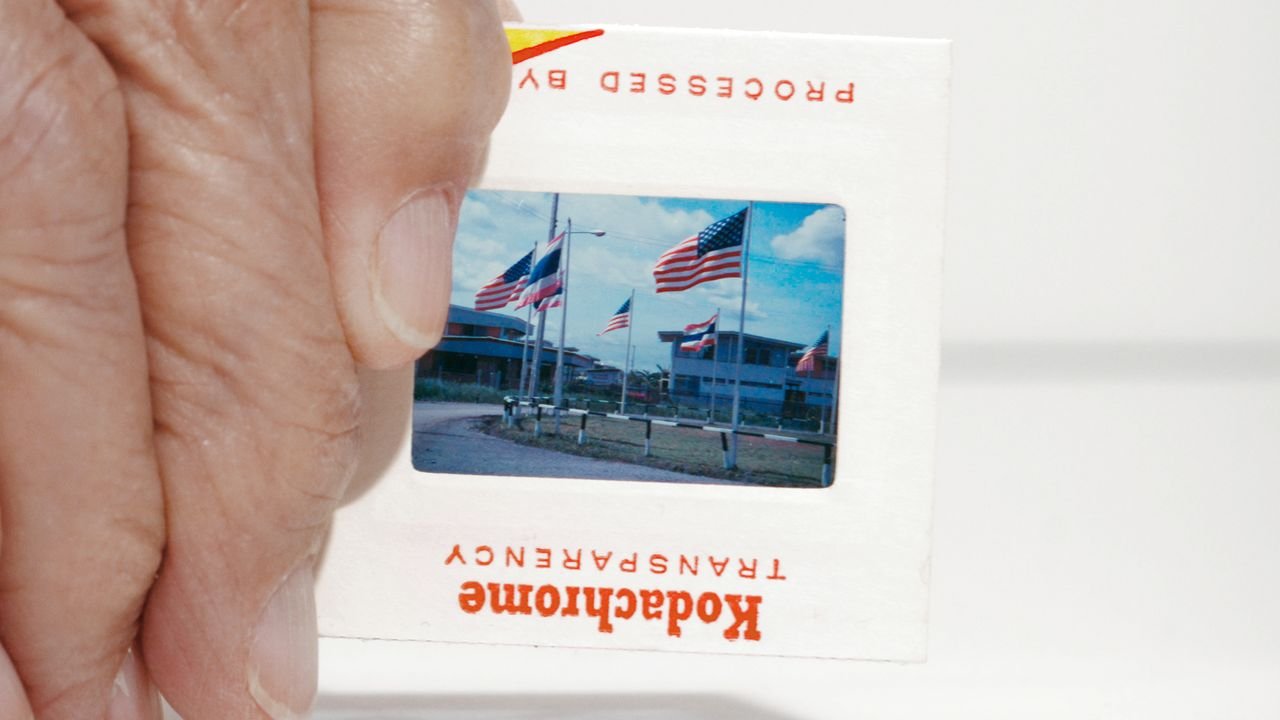
“A squad agent informed me I’d be babysitting,” 2026.Art work © Taryn Simon
Government bureaucracy and pomp have been the long-running preoccupations of Simon’s career. For “Contraband” (2010), she spent a week inside of the Customs and Border Protection Federal Inspection Site and the U.S. Postal Service International Mail Facility at J.F.K., emerging with more than a thousand photographs of confiscated goods. “An Occupation of Loss” (2016), a live installation at the Armory I wrote about in which she gathered professional mourners from various countries to enact their culturally specific death rituals, was as much about the bureaucratic process of securing entry visas as it was about the performance itself.
In this exhibit, Simon uses the palette favored by heads of state: Communist red; United Nations blue; Saudi green; the gold of the Oval Office drapes. One image, of eighty orders of large McDonald’s French fries, plays with the agent’s observation that McDonald’s shares its corporate colors with the Chinese flag. After pictures of a crowning baby and a placenta set us on our way along the agent’s early life, the first major installation, two stories high, is an homage to Cold War spycraft, a photographic grid of neckties, slide carrousels, VHS tapes, hockey players, a Soviet Life magazine, seventies-era eyeglasses, a picture of Henry Kissinger—many of which could be set dressing for an adaptation of a John le Carré novel (except, perhaps, the photograph of a John le Carré novel). This is fun, if a little on the nose, and perhaps meant to be read ironically, evidence of how one era’s urgent fears decay into another’s kitsch. The agent tells several stories of catching informants—the wall text refers to them as “un-American Rats”—and photographs of dead rats are a repeated motif.
Source link