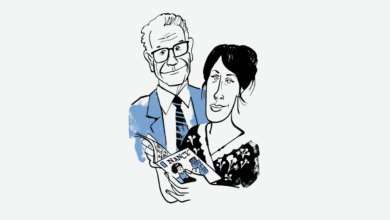


Jeff, for his part, is a smooth professional handler, providing Frances with a burner phone preloaded with his number. When Frances, frustrated by her bosses’ dismissal of her concerns, decides to feed Jeff documents, he says that he can’t physically handle any of her electronic devices—but she can leave them open and he can look. (Sorkin makes sure to hark back to the granddaddy of whistle-blowers, Daniel Ellsberg.) Jeff also takes information that Frances provides and runs with it, conducting a separate experiment, with the help of Evelyn, who mimics the Facebook activity of someone like Frances’s radicalized friend to see what the algorithm throws at her.
The bond between Frances and Jeff, however, isn’t merely instrumental; they find that they have much in common. Both are nerds, of different varieties. Frances, although fluent in tech, is also prodigiously literary, providing Sorkin fodder for several snappily written scenes. When a Facebook executive (Billy Magnussen) sneeringly compares her to the mythical prophet Cassandra, a figure he likens to the boy who cried wolf, she sets him straight: unlike the shepherd boy, Cassandra was alert to real danger. Later, Frances explains to Jeff that what made her take the risk of contacting him were the high ideals she’d absorbed from art and literature. She tells him that, nonetheless, she never intended to be a Frank Capra character, evidently meaning the ones played by Jimmy Stewart in “Mr. Smith Goes to Washington” and “It’s a Wonderful Life.” Jeff, meanwhile, is a classic-musicals nerd who has “Show Boat” blaring in the background when she calls and who has many more Capra titles on tap than she does. Both are single—Sorkin shows Frances on one disastrous date with a finance bro who, himself, imbibes misinformation from Facebook—and their mutual recognition as smart misfits seals their collaboration.
Frances is much more of a misfit, though. Jeff, after all, is part of a social profession, a caller and a persuader, and his intelligence is less purely intellectual and more rounded, whereas Frances is a quintessential academic nerd, strong in all subjects, assertive in her understanding, impatient with those who are slower on the uptake. (Jeff calls her “scary mean.”) She is detail-oriented and tautly literal, full of intellectual self-confidence, and exasperated by its social price. In effect, she plays the role in “The Social Reckoning” that the character of Mark Zuckerberg played in “The Social Network”: she’s the genius whose insight, passion, and inspiration are the engine of the story, and she’s the character at whom the movie looks beamingly and wondrously. Jeff, on the other hand, serves the drama much as the role of Sean Parker (played by Justin Timberlake) did in the earlier film. He’s the worldlier player, whose experience and institutional connections are essential for the genius character to have an impact on the world stage.
Although “The Social Reckoning” has as wide a purview as its predecessor, it feels much narrower. It ranges through the highest reaches of power—a tech behemoth, a mighty newspaper, the halls of Congress—in such critical times as the start of the COVID-19 pandemic, and the 2020 election, the attempted coup on January 6th, yet it still feels small. This is partly because Sorkin’s narrative, zipping back and forth in time between events from 2019, 2020, and 2021, forces scenes into spartan simplicity for the sake of clarity. And perhaps life itself feels smaller now, compared with the era depicted in “The Social Network,” likely because of the shift in attention caused precisely by social media. Where life used to mean living with heads up and gazing outward at the world at large, heads are now turned down, gazing at tiny screens where the truer and realer aspect of life seems, absurdly, to be happening. The recent turn to online life has no history, personal or public, in the film, which hardly gives that epochal transition any play. Sorkin’s story is assembled with precision, its information dispensed to yield pieces that fit together exactly and without excess. As a result, the characters are shorn of any traits that don’t serve the outcome—and so is the world around them.
In “The Social Reckoning,” Zuckerberg first shows up in a lecture hall at Facebook, being coached by a public-relations strategist named Raya (Wunmi Mosaku), for an appearance before a Senate committee. He is going to be asked about Section 230 of the Communications Decency Act and is preparing to testify that repealing this section would “kill the internet,” by forcing Facebook and other platforms to vet and suppress, or, he says, censor people’s posts. (He will suggest that the internet and social media need proper regulation, by law, from Congress itself.) But there’s no discussion of what makes Section 230 so crucial, which is that it defines internet platforms as common carriers rather than publishers, akin to phone companies rather than newspapers. Just as a phone provider isn’t responsible for fraudulent or libellous remarks made by callers, e-mail services and social-media sites are given similar exemption.
Source link