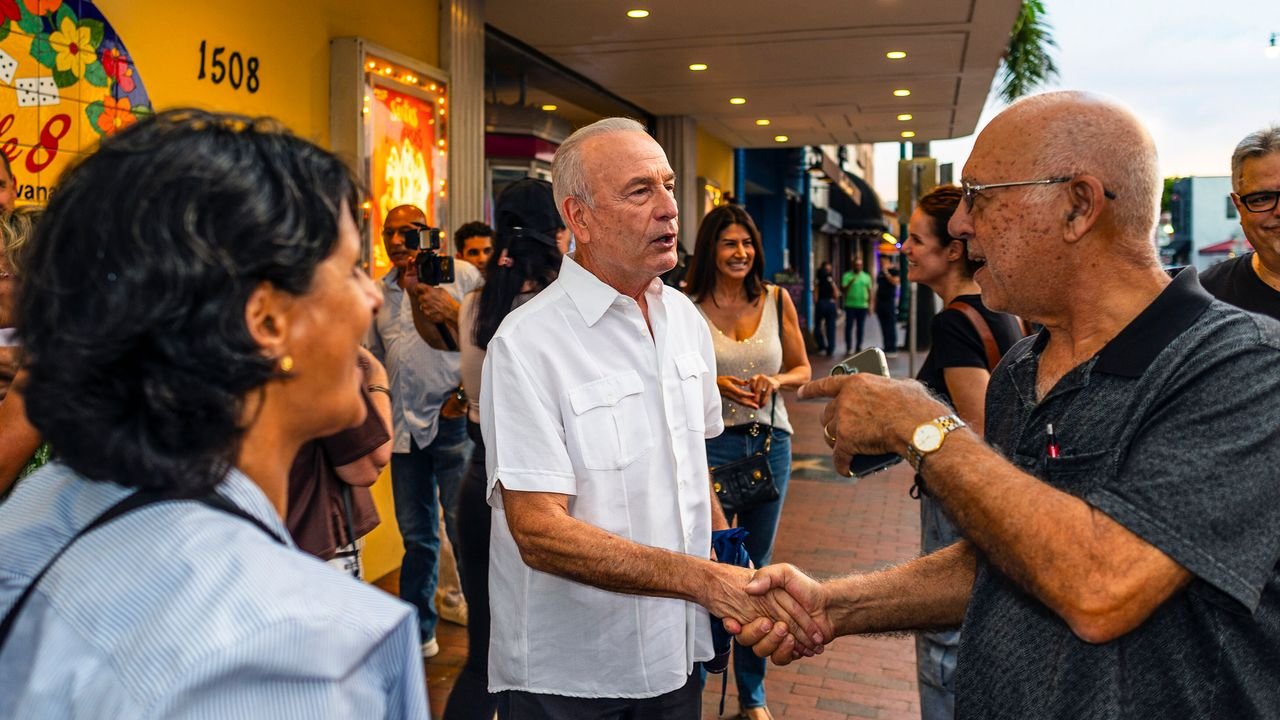

The current Administration’s crushing sanctions and blockade on oil shipments to the island have made Trump popular among Miami Cubans. And some right-wing politicians in Latin America allied with the White House have endorsed Salazar, including María Corina Machado, the exiled Venezuelan politician who won the Nobel Peace Prize, and the Colombian President, Abelardo de la Espriella. But, in this election, both candidates have attempted to claim the mantle of anti-communism. Rodriguez, in addition to covering Miami’s biggest stories, such as the Mariel boatlift and Hurricane Andrew, had also reported from inside Communist regimes such as Venezuela, Nicaragua, and Cuba, once even interviewing Fidel Castro, and recently attacked Salazar in a Spanish-language social-media post over the Trump Administration’s partnership with the socialist government in Venezuela. (He isn’t a fan of Zohran Mamdani’s plan for government-owned bodegas, either.)
In a reflection of the race’s tricky political balancing act between long-term and more recent exiles, Rodriguez said that he still has family in Cuba and believes that the Administration’s economic strangulation of the island is hurting citizens more than the government. “I think people have opened their eyes that Trump’s policy toward Cuba is not about restoring democracy—it’s about enriching himself,” Rodriguez told me. In response to de la Espriella’s and Machado’s endorsements of Salazar, he said that he was more focussed on families struggling to make ends meet in Miami.
After all, the campaign would need more than Little Havana. Though Rodriguez’s campaign has gained momentum, fuelled by the same anti-Trump resentment that has powered the Republican-turned-Democrat former congressman David Jolly’s run for governor and the Democratic state legislator Angie Nixon’s Senate campaign, Republicans maintain a strong grip on the district and have been significantly outpacing Democrats in voter registration throughout the state. Since 2020, national Democrats and their allies have all but abandoned Florida financially. Susan Whitman-Helfgot, the co-finance chair of Democratic Hispanic Caucus of Florida, was motivated to get involved anyway. She helped found the West Miami Dems, a voter-registration group, after the 2024 Presidential election, newly determined to make Florida a swing state again. “You need to pull in the no-party voters. It’s not an easy sale, but it can be made,” she told me.
The stakes for voter engagement are particularly high for this year’s elections in Florida, she explained, in the face of recent Republican-led changes to state election laws that will de-register voters who do not participate, as well as a swell of disinformation aimed at disenfranchising Latino voters. Some Latinos told her that they thought they weren’t allowed to vote in congressional elections as independents. Others mentioned hearing at church that they simply couldn’t vote this year. She was also quick to point out that, although Latino voters were not a monolith, the Trump Administration’s immigration crackdown had increasingly become a political wake-up call for those affected by it. “It changes when it’s personal,” she said. “When you’re Venezuelan, and you’ve had a family member thrown out, it’s a whole different ballgame.”
That sentiment dovetailed with a 2025 poll of mostly long-term Venezuelan immigrants in Florida by Florida International University’s Latino Public Opinion Forum, which found that thirty-five per cent of respondents had family or a close friend affected by the termination of T.P.S. Of all the poll’s participants, a fifth of those who had voted for Trump now regretted it. Trump, for his part, did not seem concerned. After initially shrugging off questions about Salazar’s ad, he reposted more than a dozen posts attacking her on Truth Social: “She is nothing but a back stabber,” one post read. “I’m glad Latino support hasn’t wavered.” Another read, “So we need a NEW Republican to Replace Salazar.”
In the days after the ad, Salazar appeared on CBS News’ “Face the Nation,” saying that she spoke with Trump and had a “fantastic conversation” with him, adding that he was “courteous” and “very receptive.” It was unclear whether her ad was a reaction to any new voter data, but, since its release, she had been keeping a relatively low profile in Miami. Shortly after meeting with Rodriguez, I reached out to Salazar’s spokesperson for an interview, even visiting her office on Eighth Street, where a Cuban flag emblazoned with the word “Libertad” hung on the wall, but my repeated requests were unanswered. Then, a few days later, I received a tip that the congresswoman would appear at a Mass at Our Lady of Lebanon, a Maronite Catholic church back in Little Havana that serves a diverse community of Lebanese and of Latino descent. At the conclusion of an English-language service interspersed with hymns in Arabic, the priest introduced Salazar, who stood up in the front row, smiling and waving. She walked with him into an adjoining banquet hall, where she shook hands and posed for pictures. As I approached Salazar, a young woman stepped in front of me and began addressing her as a bearded man beside me filmed the exchange.
Source link