



The repo market in the U.S. is a mosaic of segments with distinct participants and various settlement and clearing practices. Why do large cash lenders typically settle their trades through a third-party agent? Why does the interdealer market clear through a central counterparty? Why do levered investors favor bilateral trades? In the second post of this series, we follow the cash as it navigates through repo markets to better understand the costs and benefits that shape the existing market structures.
What’s Unique about Repos?
In a repurchase agreement or repo, one party sells a security (frequently U.S. Treasuries) in exchange for cash with the promise to repurchase the security at a later date (usually the next business day). As we discussed in yesterday’s post, participants often use repos to invest cash and earn a return, similarly to federal funds or Eurodollar contracts. However, repo markets are significantly larger than other short-term money markets: For example, daily total volume across the federal funds, Eurodollar, and selected deposit markets hovers around $200 billion, while recent estimates of the size of repo markets in the U.S. exceed $13 trillion. What makes repo contracts distinctive?
The role of collateral is a key feature distinguishing repos from many other money market transactions. The presence of collateral expands the motives for entering repo transactions, attracting a broader set of participants. For instance, hedge funds may enter a repo to secure specific securities, while money market funds (MMFs) see the securities as a means to reduce the risk of their investment.
Taken together, the richness of counterparties and motives incentivizes customization in the execution, clearing, and settlement of repo contracts. Concretely, participants not only evaluate the terms of the transaction itself (for example, the rate, maturity, type of collateral, and haircut), they also assess the processes involved in the verification of the trade details (clearing) and the final transfer of the ownership of securities from the seller to the buyer in exchange for cash, including valuation, margining, and custody services (settlement). These processes involve costs arising from operational, legal, and counterparty risks. As participants deal with these costs differently, several repo segments have emerged, in reflection of how various entities evaluate these trade-offs. We describe these market arrangements next.
Intermediation Is Key in Repo Markets
How do borrowers and lenders find suitable counterparties in an over-the-counter market with many distinct sets of participants and trading motives? Repo markets have addressed this question through the emergence of dealers who act as intermediaries between the ultimate borrowers and lenders. Dealers are the hubs through which repo markets flow: they create value by intermediating cash and collateral in exchange for compensation for counterparty, collateral, and, to a lesser extent, maturity transformation risk (OFR 2024). For instance, as the stylized diagram below shows, a dealer may enter a repo—borrowing cash—with a more creditworthy counterparty (for example, a government MMF) and enter a reverse repo—lending cash—with a riskier one (for example, a levered hedge fund), earning the difference in rates (a 10 basis-point spread in this example) for intermediating between the ultimate borrower and lender.
Dealers Play a Crucial Role in Intermediating Cash and Securities
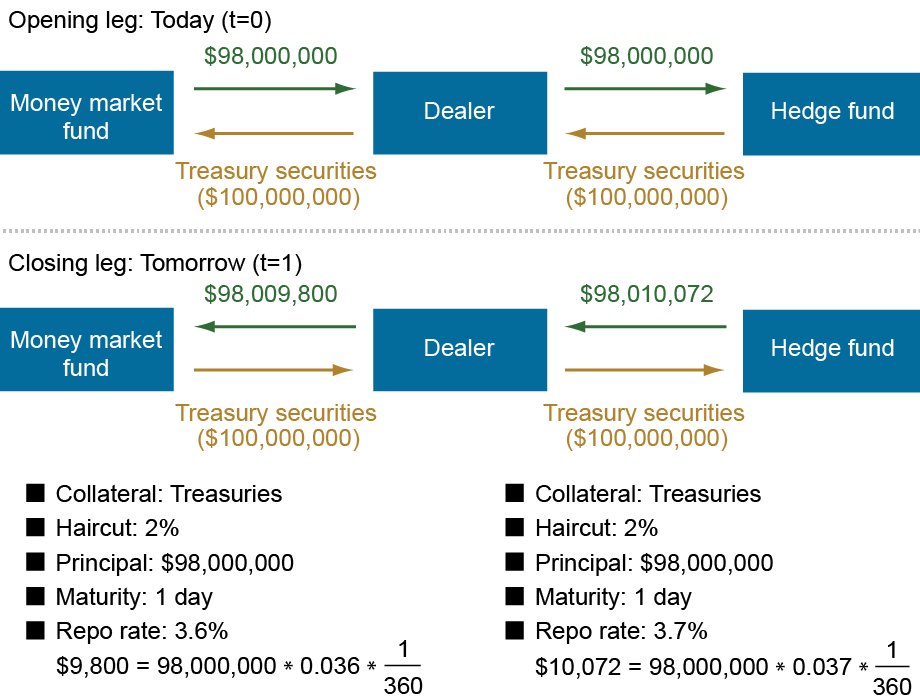
Dealers also make markets for collateral by supplying securities counterparties are seeking and by accepting securities counterparties want to borrow cash against. Their importance cannot be understated: recent estimates calculate that in late 2024 dealers borrowed and lent $3.7 trillion and $3.4 trillion per day (Hempel, Kahn, and Shephard 2025).
To manage short-term liquidity, redistribute and source collateral, and finance security inventories, dealers also actively transact among themselves in an interdealer market. Most interdealer trades clear through a central counterparty which becomes the counterparty to every trade. In the U.S., the Fixed Income Clearing Corporation (FICC) currently guarantees most Treasury repo trades in the interdealer market. A key benefit of central clearing is the greater opportunity for netting of positions, which reduces balance sheet costs and expands dealer intermediation capacity. In addition, central clearing provides dealers with anonymity on their trades and reduces counterparty risk. These benefits, however, do not come for free, as they require contributing to a default fund and higher margining (see Neal 2024 and Copeland and Kahn 2024). By June 2027, the Securities and Exchange Commission (SEC) will require central clearing of U.S. Treasury-collateralized repos where at least one counterparty is a direct member of a registered clearing agency (2023 SEC rule).
Follow the Cash
Cash typically enters repo markets through cash-rich investors such as MMFs looking for a short-term secured investment. Dealers intermediate the funds, directly or through the interdealer market, and lend to cash borrowers, often hedge funds seeking to lever their investment strategies. Having discussed the interdealer segment, we next focus on the market structures of the segments where the funds originate and end in their journey from cash lenders to ultimate borrowers.
From Lenders to Dealers
The main cash lenders in repo are MMFs. Repos offer MMFs a flexible investment to manage client redemptions that also meets regulatory requirements on asset composition: SEC Rule 2a-7 restricts MMF investments to holdings of high-quality, short-term debt securities. Government MMFs, which account for over 80 percent of total U.S. MMF assets as of March 2026, are further limited to investing in cash, U.S. government securities, and repos backed by U.S. government securities. Currently, most transactions between MMFs and dealers are not centrally cleared. Dealers are more willing to forgo the benefits of central clearing for these transactions because MMFs offer a competitive, deep, reliable source of funding.
The settlement of repo transactions entails several tasks including collateral valuation, margining, collateral management, and custodial services. As MMFs are not interested in taking possession of specific collateral, they typically invest in general collateral repos and rely on a clearing bank (currently, Bank of New York Mellon) to settle transactions on its books instead of bearing the costs of setting up back offices for collateral management. This segment of the market, where the parties outsource to an agent the collateral management to settle repo, is known as the tri-party repo market. In contrast to the centrally cleared interdealer market, tri-party repo does not transform the counterparty risk between the buyer and seller, because Bank of New York Mellon acts solely as an agent and not as a counterparty (see TMPG 2022).
While this lender-to-dealer segment historically has not been centrally cleared, MMF lending in the centrally cleared segment has increased sharply over the past three years, reaching almost 40 percent of MMF repo activity in 2026:Q1 (see chart below). This migration is consistent with the benefits of central clearing outweighing the additional costs for dealers.
Rapid Growth of Centrally Cleared Lender-to-Dealer Repo
Note: The chart shows MMFs’ private repo volume by type of clearing.
From Dealers to Borrowers
As discussed in yesterday’s post, repo is an essential tool for hedge funds to boost their returns. Dealers are the main cash lenders to hedge funds in the repo market, with hedge funds’ outstanding repo volume reaching $3 trillion in 2025:Q4. In this segment, specific securities play a crucial role and repos settle bilaterally, in contrast to the lender-to-dealer segment that largely settles through a third party.
A key consideration behind the bilateral choice is that hedge funds employ highly levered fixed-income strategies (such as the cash-futures basis trade). As such, these strategies require both flexible access to collateral and cost efficiency to profitably exploit small price differentials. The bilateral segment provides hedge funds more flexibility along the first dimension relative to the tri-party segment, where the collateral stays with the clearing bank. Regarding the second, haircuts are typically lower in this segment: 75 percent of all Treasury repo trades in the bilateral segment that are non-centrally cleared have a zero haircut (OFR 2023). Dealers can still find attractive the non-centrally cleared market because there could be opportunities for freeing balance sheet space through so-called “netted packages.” For example, another type of hedge fund strategy involves the use of a reverse repo to purchase a cheap “off-the-run” security and a repo to source an “on-the-run” security for a short position. This combination of a repo and a reverse repo with the same counterparty and tenor and similar collateral could be eligible for balance sheet netting without the involvement of a central counterparty and therefore is well-suited to be executed via a netted package.
Consistent with the trend towards central clearing, the next chart illustrates that an increasing volume of repo between hedge funds and dealers has centrally cleared over the past three years, from 8 percent in early 2021 to 30 percent in late 2025. Recent analysis shows that this activity tends to increase on quarter-ends when dealers’ balance sheets are more constrained (OFR 2026).
Substantial Increase in Centrally Cleared Dealer-to-Borrower Repo
Note: The chart shows the total private repo volume and the centrally cleared volume in the dealer-to-borrower segment.
To Sum Up
The various microstructures of repo segments observed in the U.S. reflect how a heterogeneous set of participants evaluate the trade-offs involved in repo transactions differently. Costs related to the settlement of securities led to the emergence of tri-party repo; balance sheet costs favor central clearing; meanwhile, creative contracting—such as netted packages—mitigates costs in bilateral, non-centrally cleared repos.

Gara Afonso is a financial research advisor in the Federal Reserve Bank of New York’s Research and Statistics Group.

Jun-Davinci Choi is a research analyst in the Federal Reserve Bank of New York’s Research and Statistics Group.

Gonzalo Cisternas is a financial research advisor in the Federal Reserve Bank of New York’s Research and Statistics Group.

Will Riordan is a capital markets trading advisor in the Federal Reserve Bank of New York’s Markets Group.
How to cite this post:
Gara Afonso, Jun-Davinci Choi, Gonzalo Cisternas, and Will Riordan, “Follow the Cash! Microstructure of Repo Markets,” Federal Reserve Bank of New York Liberty Street Economics, September 29, 2026, https://doi.org/10.59576/lse.20260929
BibTeX: View |
Disclaimer
The views expressed in this post are those of the author(s) and do not necessarily reflect the position of the Federal Reserve Bank of New York or the Federal Reserve System. Any errors or omissions are the responsibility of the author(s).
Source link