
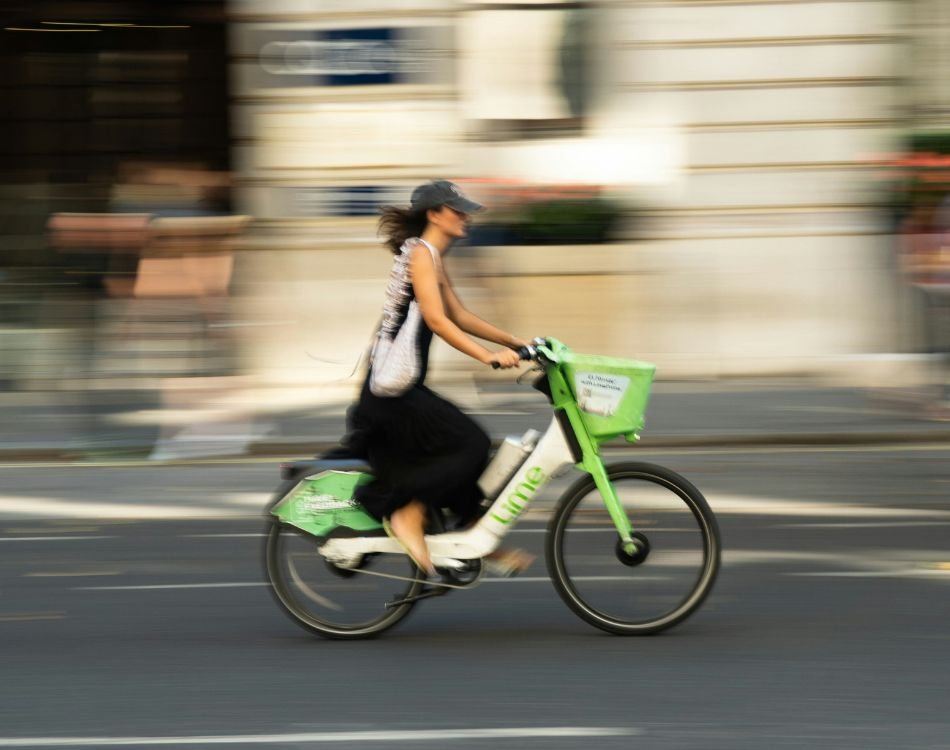

Cycling has become Londoners’ favourite way to get around town. Travel through the city on any given weekday morning and it’s like the Tour de London, with one big peloton streaming through the streets. Come evening, the roads are spotted with flashes of green, as Limers go on their way for a night out on the town. We’ve come to the point where a sea of green bikes outside a pub is a sign of a good time, like Gatsby’s green light at the end of the dock; it calls your name, telling you there’s fun inside.
On a bike, London looks so much better. Why would I choose to be in the sweaty, smelly, claustrophobic prison of the Tube, 100ft underground, when I can whizz through the streets with the wind in my hair and hope in my heart? It feels like the closest I’ll get to fulfilling my dream of moving to Amsterdam and cycling arm in arm with a tall blonde Dutchman, a bunch of fresh flowers and steaming sourdough in my basket.
Lately, though, it’s started to feel like the rest of London would rather we get back on the trains.
Like me, more and more people have fallen in love with cycling. According to last year’s TfL Travel in London report, cycling journeys were up 43% between 2019 and 2025, with daily bike journeys reaching 1.5 million.
It’s all the product of a big push from London leaders over the last couple of decades to get everyone on their bikes. TfL’s Cycle Action Plans set out the ambition of making London “the world’s best large city for cycling”, and to be fair to them, they’ve done a pretty good job. Low Traffic Neighbourhoods, residential cycle hangars and more 20mph zones have all made London more appealing for cyclists, and there are now 450km of Cycleways in the city.
The biggest factor in the bike boom, though, has been cycle hire. It all started in 2010 with the launch of “Boris Bikes”, officially known as Santander Cycles, a rare good decision from the former Mayor. Then at the end of 2018, Lime arrived and we’ve never looked back. Convenient, sustainable, zero physical exertion: what’s not to love? It might be the worst-value way to get around (buy your passes, people), but when Citymapper offers you a 40-minute journey involving three Tubes and a bus, or a 45-minute Lime, it really is a no-brainer.
Some Londoners now cycle almost everywhere, like 26-year-old Hester, who cycles anywhere within 40 minutes. “I’ll cycle to see friends, to go shopping and to go on walks in other areas. I always take the route with the most cycle lanes and I love the sets of lights that set cyclists off before cars, it gives you that extra sense of security.”
The plan worked. So why is everyone suddenly coming for cyclists?
This year, they’ve been copping it big time. The City of London Police have been out on patrol this week, waiting to catch any cyclists skipping a red light. Instead of getting the standard £50 fine, any jay-cyclists are being given the option to watch a three-minute safety video in a “cycle time out zone”. Meanwhile, social media has been flooded with clips of riders sailing through reds, like some sort of reel of shame.


This follows an investigation by the City of London Police in July, which used Lime’s tracking technology to find a cyclist who’d mounted the pavement, weaved through pedestrians and given a disapproving passer-by the finger. He’s since accepted a fine, issued an apology and been banned from using Lime for life.
It’s Limers in particular who have grown a reputation for recklessness. A recent SNL UK skit turned it into a song containing the lyrics: “If I die, then I die, if you’re in my life then you’ve got to learn to live with the fact that I could die any minute on a Lime.” We’re all victims of Liming when we maybe shouldn’t. I admit, I once decided to share one with a friend who then tried to ride look-mum-no-hands style. You can imagine how that ended.
Then there’s the parking. Frustrated pedestrians are sick of abandoned bikes clogging up the pavement and Mayor Sadiq Khan recently called on the government to speed up regulations for e-bike operators, saying the city has taken a “Wild West” approach to cycle hires. In response, Lime is giving nearly £1m to nine boroughs, including Greenwich, Lambeth and Hackney, for more parking bays.
If cyclists have a PR problem, it’s the Lime bike. It’s almost as much an accessory as it is a way to get around, with brand collabs, celebrity stunts and even a Lime jousting event this weekend. Lime has moved cycling away from geography teachers’ commutes and towards gallerinas hotfooting it to Frieze after-parties. Hey, even Kim K is in on it.
None of that helps Lime’s case. It only feeds the idea that London’s e-bike users are inexperienced cyclists lazily letting the battery do the dirty work. Theo, 24, has been cycling in London all his life, and he thinks one of the best ways to make it safer is to educate and upskill cyclists themselves. “Some people on Lime bikes aren’t very experienced, so to make it better, I’d focus on improving the quality of other cyclists and introduce deterrents for bad cycling.”
Fine, cyclists need to be more vigilant. But why are we fixating on a reckless minority when most of us are just out here trying to survive?
Many people still feel too scared to get on a bike at all. Tilly, 25, is an avid cyclist in the countryside and a spin class regular, but she won’t ride in the city. “I find being on a bike in London terrifying when there are huge buses, trucks, cars, traffic lights and people that could all cause you to be knocked over onto the road.”
Jude, 25, only cycled to work during a Tube strike. “It made me want to explode”, he said. Harry, 23, sums it up: “Cycling is great, it keeps me and the world fit. I just wish drivers would stop being so mad about it.”
The real danger on London’s roads isn’t on two wheels. The latest TfL figures show that cars continue to be the main vehicle involved in fatal collisions in London; cars were connected to 58 of the 110 fatalities in 2024.
And if we’re policing bikes, let’s police cars. Take bike boxes, the zones at traffic lights that let cyclists get ahead of traffic. Drivers who stop in them are meant to receive three penalty points and a £100 fine, yet pull up at almost any junction in town and nine times out of ten there’s a car, van or taxi sitting right in the middle of one. Instead, the police are busy pulling over cyclists for running red lights.
And can we say it? Not every red light is sacred. Since 2015, France has let cyclists go through red lights at designated crossings, as long as they give way. The thinking was that riders shouldn’t be automatons who always treat green as safe and red as danger, but should use their judgement.
Hester already rides that way: “I skip red lights but only when I know it’s safe and won’t endanger anyone else. I don’t see a problem with doing this, it means I can get ahead of the cars behind me, especially if I need to cross a lane further down the road.” We wouldn’t be mad if London followed suit.
Pedestrians aren’t blameless either. Cycling across Westminster Bridge is like a real-life version of Subway Surfers, dodging oblivious tourists who step into the cycle lane to get the perfect selfie with Big Ben. Oxford Street is the worst, though, with shoppers drifting along like lemmings, glued to their phones and stepping into the road without looking one way, never mind two.
In 2010 Boris Johnson said he hoped bikes would become as common as black cabs and red buses in the capital. Sixteen years later, they are. But while the number of cyclists has increased at an impressive rate, regulation and infrastructure haven’t been able to keep up. We still see the lanes that vanish at the junction where you need them most, the e-bike parking bays that are full by 9am and the police who’ll stop a cyclist at a red but rarely a driver in a bike box. Until this is fixed, our message to the critics is simple: on yer bike.
Featured image credit: Ellen Chaffin on Unsplash