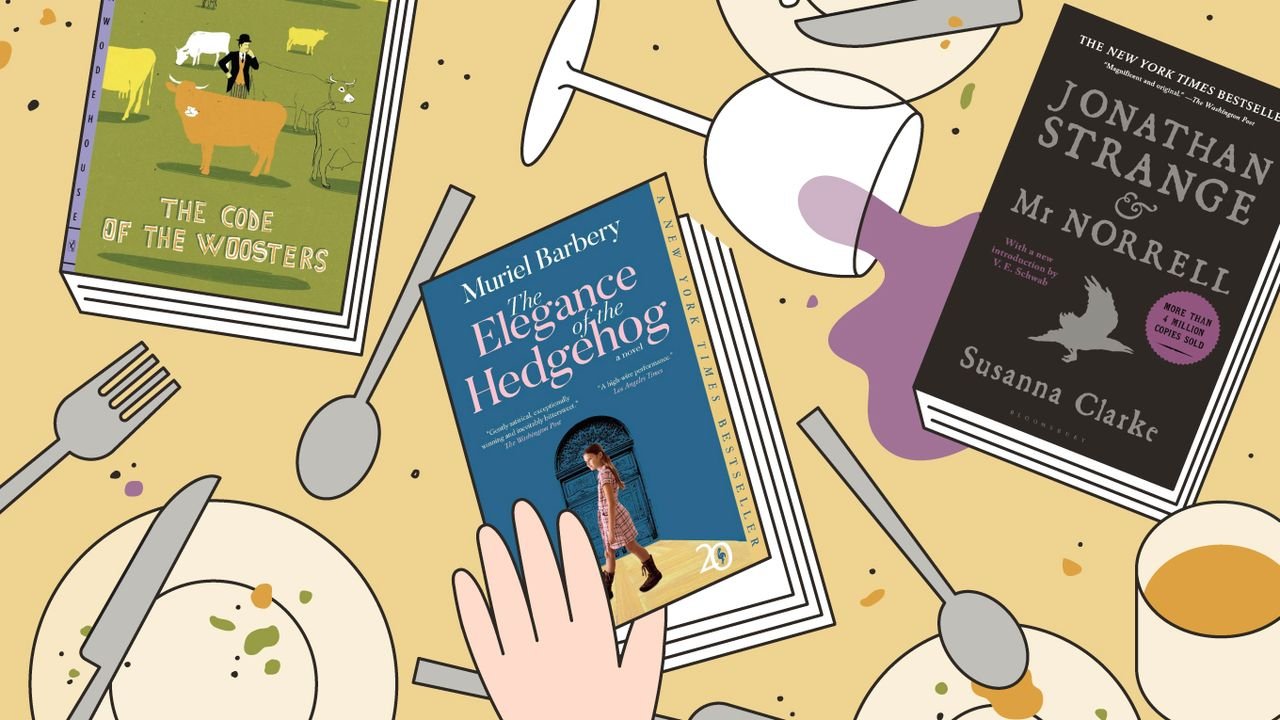

Wodehouse peppers all his novels—glittery farces of interwar, upper-crust foolishness—with absurd and wondrous culinary details. None of these is so delightfully luscious as the Escoffierian handiworks of Anatole, the tempestuous French chef employed by Bertie Wooster’s Aunt Dahlia, whom she calls “God’s gift to the gastric juices.” Poor Anatole’s services (or the withholding thereof) are a near-constant engine of blackmail, betrayal, and other plot-fuelling choreography throughout all the Jeeves and Wooster stories. So magnificent is his cooking that, in “The Code of the Woosters,” Bertie is willing to spend a month in jail on false charges for the promise of, upon his release, an Anatolian dinner “that will live in legend and song.” The devised menu begins with caviar frais, cantaloup, Consommé aux Pommes d’Amour, Sylphides à la crème d’Écrevisses, Mignonette de poulet petit Duc, Points d’asperges à la Mistinguette—and that barely brings us to the foie gras, let alone to the Timbale de ris de veau Toulousaine, or (naturally) Le Plum Pudding.
“Land of Milk and Honey,” by C. Pam Zhang
There’s no end of exquisite food in this novel whose unnamed chef narrator often sinks into transportive sensory descriptions—at times overtly erotic, at times verging on body horror—while cooking for a group of billionaires hiding from global environmental collapse in a mysterious mountaintop enclave. So many food-forward novels use the lushness of appetites as a straightforward metaphorical tool; what I love about this book is the way its narrator wrestles with the angel of her own sensory rapture. The pleasures of culinary abundance are a symptom of vicious neo-feudalism, not a relief from it. “Butter doesn’t make the cake, nor cream,” the narrator notes of a cheesecake soufflé. “Its secret is ephemerality. Pull it from the oven and it is perfect; the next moment it is cooling, flattening, collapsing beneath the gravity of time. This is a flavor untasted by diners and critics, no record of its existence but for a private memory that lingers on one or two tongues.”
For more recommendations: see Helen Rosner’s gift guide of snacks, trinkets, and culinary-minded treasures.

Our editors and critics choose the most captivating, notable, brilliant, surprising, absorbing, weird, thought-provoking, and talked-about books. Find your next great read »
Coming soon:
- December 1st brings Colm Tóibín’s “The Bridge,” a follow-up to “The Long Winter,” which he published twenty years ago. The new novella picks up the story of the closeted Miquel and his father, who are smugglers living in a remote valley in the Catalan Pyrenees, in the nineteen-fifties.
-
“Fabrications,” by Zach Mason, is a collection of short stories set in the near future, mostly told from the perspective of A.I. It’s also coming out on the 1st.
-
Stephanie Krzywonos spent seven seasons living and working in Antarctica, trying to process her grief over losing a dear friend. “The Blue Hours,” also out on the 1st, is her memoir of that time.
P.S. Agatha Christie’s “The Mousetrap,” the longest-running play in the world, opened in London’s West End on this day in 1952. Whitney Balliett, who reviewed it for the magazine in 1960, might be surprised to hear that the show is still going strong. 🎭
Source link