



There is little consensus on the effect of AI adoption on employment. Economy-wide measures of pay and headcount have moved little even as AI adoption has spread rapidly, yet narrower measures document declining hiring for workers at the start of their careers or in AI-exposed occupations. In this post, we revisit this topic for U.S. small businesses. We use data from the 2025 Small Business Credit Survey (SBCS) to examine the twelve-month-forward employment and revenue expectations of AI users. We find that firms currently using AI are significantly more likely than non-users to expect increased employment and revenues over the next year, even after accounting for firm and owner characteristics and location. Revenue expectations are most optimistic for AI users that report facing operational challenges in utilizing technology.
AI Use by Large and Small Businesses
Unlike larger firms, which develop their own AI infrastructure, small businesses may lack staff capacity, technical expertise, and resources to decide how best to apply AI tools. On the flip side, smaller firms may be less likely than larger firms to face coordination challenges when integrating AI. Indeed, the concurrent surge in national business startups with the growing adoption of AI suggests that these tools may be a positive force for small businesses.
In the SBCS report on findings from the 2025 survey, 46 percent of firms with at least one employee stated that their business or employees were using AI tools, with another 15 percent planning to adopt them in the next twelve months. Furthermore, among AI users, 63 percent said that AI was somewhat or very important to production and 51 percent had integrated AI partially or fully in their business processes.
AI Adopters More Optimistic on Revenue and Employment Growth Than Non-Adopters

Notes: The chart shows the employment and revenue expectations of AI adopters and non-adopters. The vertical axis shows the diffusion indexes (percentage expecting an increase minus percentage expecting a decrease) of responses to this question in the AI module: “How does your business expect its [revenue/number of employees] to change over the next twelve months?” Module responses are weighted on a variety of firm characteristics in order to match the national population of employer firms. The survey was fielded between September and November of 2025. Total number of employer firms in the AI module: 5,248.
In the SBCS survey, 77 percent of respondents reported no change in their firm’s current labor costs from the use of AI. Respondents also reported their expectations for employment generation for the twelve months following the survey. Among firms with at least one employee, those who currently use AI had a 33 percentage point net expectation of higher employment in the next twelve months, while non-users had only a 15 percentage point net expectation (see chart above). When we consider owners either using or planning to use AI, we obtain a similar difference and establish its statistical significance (see “No controls” in the chart below).
AI Adopters More Optimistic on Employment Growth Than Non-Adopters Even After Accounting for Owner and Firm Characteristics
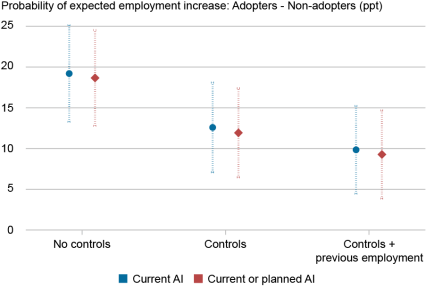
Notes: The chart shows the net probability of expected employment growth of AI adopters relative to non-adopters. The filled markers are estimates from a regression of AI use on firms’ expected employment growth, while the dotted lines show 95 percent confidence intervals. Estimates are in percentage points and measure differences in the probability of an expected increase minus the probability of an expected decrease, relative to firms who did not report using AI. AI module responses are weighted on a variety of firm characteristics in order to match the national population of employer firms. The survey was fielded between September and November of 2025. Number of employer firms in the controlled sample: 4,769.
Firm expectations could be explained by firm characteristics instead of AI use—for example, younger owners may be more optimistic. Indeed, we find that younger and more profitable firms—and those with more than ten employees—are likelier to have more optimistic employment expectations. But even after including these additional demographic and location variables, the net probability of expected employment growth remains higher for AI users than for non-users (by 13 percentage points; see “Controls” in the chart above).
Perhaps owners with positive past outcomes harbor optimistic expectations about future outcomes, independent of AI use. Indeed, we find that actual changes in employment in the past twelve months are correlated with the expected changes in the next twelve months. However, even after we include past employment changes in the analysis, the gap in expected employment growth between AI users and non-users remains positive (at 10 percentage points; see “Controls + previous employment” in the chart above).
Could owners who are optimistic about their current financial condition be more likely to use AI and to have positive employment expectations? To address this question, we use the firm’s description of its current financial condition as either “good or better” or “fair or poor” as a proxy measure for optimism. If the former group shows a greater association between AI use and employment optimism, then it may indicate a spurious correlation between these characteristics. But we find the opposite to be true: In the sample of owners who report fair or poor current financial conditions, the net probability of expected employment growth is 21 percentage points higher for AI users than for non-users, while the difference is only 10 percentage points among owners reporting good or better conditions.
Among AI users, those who report that AI is fully or partially integrated and those who regard AI as somewhat or very important to production are equally likely to expect higher relative to lower employment compared to those who are experimenting with AI, after we account for firm and owner characteristics.
AI Use and Revenue Expectations of Small Businesses
Only 31 percent of survey respondents reported increased sales from their firm’s use of AI. Respondents also reported their expectations for revenue performance for the twelve months following the survey. We find that among employer firms that currently use AI, the share expecting revenues to increase exceeded the share expecting them to decrease by 48 percentage points, compared with only 21 percentage points among non-users (see the bar chart above). When we consider owners either using or planning to use AI, we obtain an almost identical difference (see “No controls” in the chart below).
AI Adopters More Optimistic on Revenue Growth Than Non-Adopters Even After Accounting for Owner and Firm Characteristics
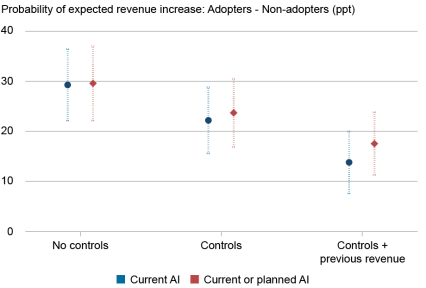
Notes: The chart shows the net probability of expected revenue growth of AI adopters relative to non-adopters. The filled markers are estimates from a regression of AI use on firms’ expected revenue growth, while the dotted lines show 95 percent confidence intervals. Estimates are in percentage points and measure differences in the probability of an expected increase minus the probability of an expected decrease, relative to firms who did not report using AI. AI module responses are weighted on a variety of firm characteristics in order to match the national population of employer firms. The survey was fielded between September and November of 2025. Number of employer firms in the controlled sample: 4,698.
After we account for firm and owner characteristics and past-twelve-month revenue changes, AI users still have a 14 percentage point advantage over non-users in net expected revenue growth (see “Controls + previous revenue” in the chart above). Of owners reporting fair or poor current financial conditions, the difference in net expected revenue growth between AI users and non-users is 24 percentage points, compared with just 15 percentage points for those reporting good conditions, and these differences are statistically significant. In other words, it seems unlikely that the association between AI use and positive revenue expectations is spurious.
Why Do AI Users Have Optimistic Expectations?
AI may be particularly helpful for small firms in dealing with operational challenges such as hiring, marketing, and technology-related issues. The SBCS asks respondents whether they faced any operational challenges “utilizing technology (e.g., website, social media, ecommerce, cybersecurity).” We find that among AI users, those currently facing technology challenges have a 16 percentage point higher net expectation of revenue growth than those who do not report being so challenged. These results suggest that AI may improve revenue expectations by helping firms overcome internal technological constraints that would otherwise limit growth.
Summing Up
AI use is associated with more optimistic expectations about future employment and revenue growth, even after accounting for firm and owner characteristics. This result is not due to optimistic owners being more likely to use AI and having positive expectations. The association between AI adoption and revenue expectations is especially strong among firms in weaker financial condition and among firms that report challenges utilizing technology. This suggests that AI may be helping some small businesses overcome specific operational or technical constraints that limit revenue generation, rather than simply reflecting broad-based optimism or expectations of expansion through hiring. Whether AI-adopting firms actually experience the stronger revenue and employment outcomes they anticipate is a subject for future research.

Will Aarons is a research analyst in the Federal Reserve Bank of New York’s Research and Statistics Group.

Asani Sarkar is a financial research advisor in the Federal Reserve Bank of New York’s Research and Statistics Group.
How to cite this post:
Will Aarons and Asani Sarkar, “AI Adoption and Employment Expectations: Evidence from a Survey of Small Business Owners,” Federal Reserve Bank of New York Liberty Street Economics, October 8, 2026, https://doi.org/10.59576/lse.20261008
BibTeX: View |
Disclaimer
The views expressed in this post are those of the author(s) and do not necessarily reflect the position of the Federal Reserve Bank of New York or the Federal Reserve System. Any errors or omissions are the responsibility of the author(s).
Source link